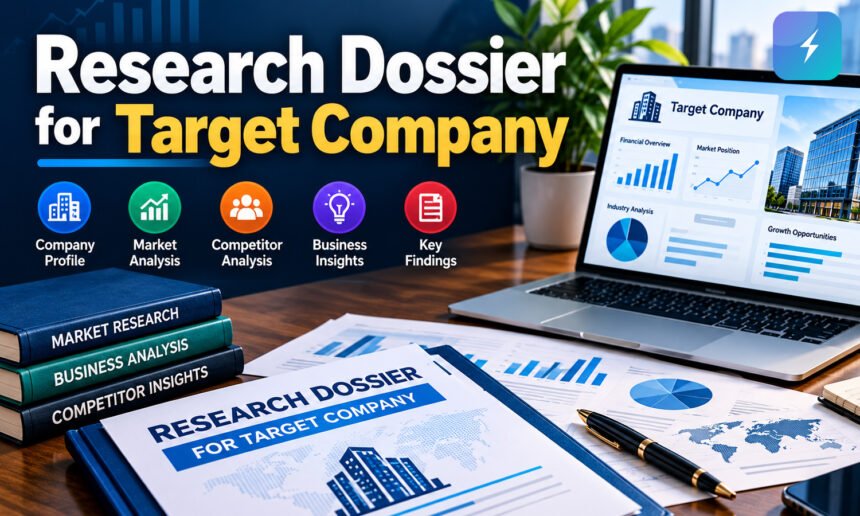
A research dossier for target company analysis is a structured document that brings together reliable information about a business in one place. Rather than collecting disconnected facts from search engines, company websites, news stories, databases, and social profiles, a dossier organizes evidence around a clear research objective. It can cover the company’s identity, ownership, products, business model, leadership, financial information, competitors, market position, technology, reputation, risks, and recent developments.
The term “target company” simply means the organization selected for research. It should not automatically be confused with Target Corporation, the U.S. retailer. Depending on the project, the target might be a prospective customer, supplier, competitor, investment opportunity, acquisition candidate, employer, or potential business partner.
A strong dossier does more than answer “What does this company do?” It also asks: How do we know this information? How current is it? What remains unknown? And what does the evidence mean for the purpose of the research? These questions turn ordinary company research into a useful decision-support resource.
What Is a Research Dossier for a Target Company?
A research dossier for a target company is an organized collection of verified company information, supporting evidence, and analysis. Its scope changes according to the reason the company is being studied.
A simple company profile might identify a company’s headquarters, founders, products, industry, and executives. A research dossier normally goes further by connecting those facts to business performance, customers, competitors, strategic developments, risks, and the researcher’s specific questions. It should also preserve the sources and dates behind important findings.
For example, finding a revenue figure is only the beginning. A careful researcher should establish which reporting period the number covers, whether it comes from the company or another source, whether the figure represents consolidated or segment revenue, and whether an appropriate comparison with earlier periods is available.
The dossier therefore has two closely related functions. First, it creates an organized record of what is known. Second, it provides a framework for interpreting that information without presenting assumptions as facts.
Why a Target Company Research Dossier Matters
Modern company research can become fragmented very quickly. Leadership information might appear on an official corporate website, financial information in regulatory filings, customer opinions on review platforms, employment information on career pages, and strategic developments in company announcements or reputable news coverage.
A research dossier provides a central structure for these findings. This makes it easier to see contradictions, outdated information, missing evidence, and areas requiring additional investigation.
Such dossiers can support several legitimate business activities, including competitive intelligence, B2B sales research, investment research, supplier evaluation, partnership assessment, marketing planning, academic research, and preliminary acquisition research.
However, a research dossier is not automatically equivalent to formal due diligence. High-stakes transactions can require specialist financial, legal, tax, cybersecurity, regulatory, technical, or operational reviews. A public-information dossier can help identify questions and potential issues, but it should not be treated as a substitute for professional verification where that is required.
Start With a Clear Research Objective
One of the most important parts of target company research happens before information is collected: defining why the research is being conducted.
Without an objective, researchers can spend hours collecting interesting information that has little relevance to the actual decision. A dossier intended for a sales team, for example, should not necessarily have the same emphasis as one prepared for an investor.
A research objective might be:
- Evaluate the company’s business model, financial position, competitive environment, and publicly identifiable risks.
- Understand a prospective customer’s products, priorities, leadership, and likely business needs.
- Compare a competitor’s products, positioning, pricing information, and market presence.
- Examine a supplier’s operations, reputation, capabilities, and possible dependencies.
- Create a documented company overview for academic or strategic research.
The researcher should also define the exact legal entity or business unit being investigated, relevant geographic markets, reporting period, and important research questions. These boundaries reduce the risk of combining information about unrelated subsidiaries, similarly named businesses, or different reporting periods.
Core Information to Include in the Dossier
There is no universal dossier template that works equally well for every company and purpose. Still, several categories appear consistently in practical company-research frameworks.
A useful structure can include:
| Research Area | Information to Examine |
|---|---|
| Company identity | Legal name, official website, headquarters, industry and ownership |
| History | Founding, important milestones, acquisitions and expansion |
| Business model | Customers, revenue sources, distribution and value proposition |
| Products/services | Main offerings, customer groups and positioning |
| Leadership | Executives, directors and relevant management changes |
| Financial information | Revenue, profitability, cash flow, debt or funding where publicly available |
| Market | Industry conditions, customer segments and geographic presence |
| Competitors | Comparable companies and competitive differences |
| Workforce | Employee information and hiring activity where verifiable |
| Technology | Platforms, patents, infrastructure or technical capabilities when publicly documented |
| Legal/regulatory | Relevant proceedings, filings and regulatory exposure |
| Reputation | Customer, employee and stakeholder signals |
| Recent developments | Acquisitions, launches, partnerships and leadership changes |
| Risks and unknowns | Verified concerns, dependencies and unanswered questions |
| Evidence log | Sources, dates, reporting periods and verification notes |
The amount of detail devoted to each category should depend on the research objective rather than a desire to make the document longer.
Understanding the Company’s Business Model
Knowing what a company sells does not necessarily explain how its business works. Business-model research investigates how the company creates value, reaches customers, and generates revenue.
Start with the company’s main products and services. Determine whether it primarily serves consumers, businesses, governments, or a mixture of customer types. Then investigate how customers purchase the offering: direct sales, retail stores, marketplaces, distributors, subscriptions, licensing, advertising, usage-based billing, or another documented model.
For diversified businesses, individual segments may operate differently. One division may sell physical products while another generates recurring service revenue. Combining them into a single simplified description can hide important distinctions.
Researchers should also distinguish confirmed revenue sources from assumptions. A pricing page can show how a product is offered, but it does not necessarily establish which plan produces most of the company’s revenue.
Financial Performance and Funding Research
Financial analysis is usually easiest for public companies because regulatory filings and audited reports may provide detailed statements. Private companies often disclose much less, making it especially important to label unavailable information as unknown instead of filling gaps with estimates presented as facts.
Depending on availability and relevance, financial research can examine revenue, operating income, net income or loss, cash flow, assets, liabilities, debt, capital expenditure, segment performance, financing rounds, and other reported measures.
Dates and definitions are critical. An employee figure from 2023 should not silently be combined with 2026 revenue as though both describe the company at the same moment.
When analyzing trends, compare like with like whenever possible. Annual revenue should generally be compared with another annual period using a consistent definition. Changes in accounting treatment, acquisitions, divestitures, or reporting structures can make apparently simple comparisons misleading.
Financial numbers should therefore be accompanied by context, source information, and reporting periods.
Leadership, Ownership, and Corporate Structure
Leadership research helps explain who holds responsibility for important parts of the organization. Relevant information may include the chief executive, finance leadership, board members, founders, significant publicly disclosed owners, parent organizations, and important subsidiaries.
Official leadership pages, regulatory filings, government corporate registries, and company announcements are useful starting points. Older biographies or third-party directories should be checked against newer primary sources before being treated as current.
Management changes can also matter. A newly appointed CEO, CFO, or business-unit leader may indicate an organizational transition, but the dossier should avoid guessing about motives unless reliable evidence exists.
Ownership requires similar care. A brand name may not be the legal entity responsible for a product. Likewise, a subsidiary’s results should not automatically be treated as the financial results of the parent organization.
Market Position and Competitor Analysis
Competitor analysis is more useful when researchers explain why two businesses compete rather than merely creating a long list of company names.
A genuine competitor may serve similar customers, solve the same problem, sell a substitute product, operate in the same geographic market, or compete for the same spending budget.
Useful comparison criteria can include product scope, target audience, distribution, geographic coverage, publicly listed pricing, customer positioning, business model, and documented differentiators.
Market-share figures deserve special attention because different research firms can define a market differently. Before quoting a percentage, check the market definition, geography, time period, methodology, and source. If those details cannot be verified, it is safer to describe the company’s presence without inventing a precise ranking.
Competitor analysis should also remain evidence-based. Marketing language such as “industry-leading” should be attributed to the company unless independent evidence supports the characterization.
Technology, AI, and Automation in Company Research
Technology now plays two different roles in a research dossier. First, researchers may investigate the technology used or sold by the target company. Second, technology can help researchers build and maintain the dossier itself.
Search platforms, corporate databases, spreadsheets, document-management systems, financial databases, news-monitoring services, and data-analysis tools can make company research more efficient.
AI systems can also help classify documents, summarize lengthy filings, extract candidate facts, compare reports, organize notes, identify possible inconsistencies, and generate questions for further investigation.
However, AI-generated output should not automatically be considered verified evidence. A language model may misunderstand a source, combine companies with similar names, omit qualifications, or produce unsupported details. Important findings should therefore be checked against the underlying source before publication or use in a business decision.
Automation is most useful for repetitive tasks such as collecting new filings, detecting changes, organizing documents, or flagging information for human review. Final interpretation still requires context and source evaluation.
Integrations and Research Workflow
A dossier can be maintained in an ordinary document, but larger research projects often benefit from connecting several systems.
A team might store structured company information in a spreadsheet or database, maintain supporting documents in cloud storage, track prospects in a CRM, and use monitoring tools to identify new company announcements or filings.
The important principle is traceability. A reader should be able to move from a conclusion to the supporting evidence without searching through dozens of unrelated files.
A practical evidence record might include the claim, source title, source organization, source location, publication or reporting date, access date, relevant reporting period, verification status, and research notes.
This approach is particularly valuable when multiple people contribute to the same dossier because another researcher can understand where a finding came from and determine whether it needs updating.
Security, Privacy, and Ethical Research
Company intelligence should be collected responsibly. A legitimate research dossier normally relies on public, licensed, authorized, or otherwise lawfully accessible information.
Researchers should distinguish business-relevant public information from unnecessary personal information about individuals. Collecting large amounts of personal data simply because it can be found online does not automatically make that information relevant or appropriate.
Internal research systems also need suitable access controls. Sensitive commercial analysis, licensed database exports, confidential notes, or documents supplied under an agreement should not be placed in unrestricted folders or public AI systems without considering applicable policies and contractual obligations.
Security becomes particularly important during transactions or supplier reviews, where a dossier may eventually contain non-public information. Organizations should follow their legal, privacy, information-security, and data-retention requirements.
How to Verify Information Properly
Verification is what separates a useful dossier from a collection of search results.
For major claims, primary sources are generally the best starting point. Depending on the company and jurisdiction, these can include regulatory filings, annual reports, government registries, official corporate documents, investor-relations materials, court records, patent databases, and company announcements.
Reputable independent reporting and established industry sources can then add context or provide perspectives that the company itself may not discuss.
Each important finding should ideally answer four questions:
Who published it?
Identify the organization responsible for the information.
When does it apply?
Record both the publication date and the period represented by the data where relevant.
Can another source confirm it?
Important or surprising claims may deserve independent corroboration.
Is it a fact, estimate, company claim, or analysis?
These categories should not be mixed together.
If a fact cannot be verified, the dossier should state that clearly.
Separating Verified Facts, Estimates, and Unknowns
One of the most useful practices in a professional research dossier is assigning an evidence status to information.
A verified fact is supported by sufficiently reliable evidence. A company-reported claim comes directly from the business but may not have independent confirmation. An external estimate comes from a third party and should retain its methodology and date where available. Analysis represents the researcher’s interpretation of evidence. An unknown is information that could not be established from the available sources.
This separation prevents confidence from being overstated.
For example, if a private company does not publish revenue, writing “Revenue: unknown from reviewed public sources” is more useful than inserting an unexplained number from an unreliable directory.
Unknowns can themselves become important findings because they identify questions that require direct confirmation.
Reputation and Customer Research
Reputation research can add useful context, but it is also easy to misuse.
Customer reviews, employee feedback, social-media discussions, forums, app-store reviews, and complaint platforms may reveal recurring themes. However, they should not automatically be treated as representative of the company’s entire customer or employee population.
Look for patterns rather than isolated comments. Consider the number of reviews, time period, platform, possible selection bias, and whether the company has responded.
Independent reporting can provide additional context when a reputational issue has broader significance. Company statements should also be included where they materially address the issue.
The objective is not to prove that a company has a “good” or “bad” reputation. It is to document relevant signals, their sources, and their limitations.
Risks, Opportunities, and Research Gaps
A mature research dossier identifies both favorable and unfavorable evidence.
Potential risk areas can include customer concentration, supplier dependence, regulatory exposure, financing needs, cybersecurity issues, litigation, intense competition, leadership turnover, geographic concentration, or dependence on a limited product range. These should only be included when supported by evidence relevant to the target company.
Opportunities might involve documented expansion plans, growing customer segments, new products, partnerships, geographic expansion, or operational improvements.
Researchers should avoid converting possibilities into predictions. A new market can represent an opportunity without guaranteeing future revenue.
A separate research gaps section is especially valuable. It can record information that remains unavailable, contradictory, outdated, or dependent on company confirmation.
Real-World Uses of a Target Company Dossier
Different users can adapt the same research framework for very different objectives.
A sales professional might examine products, business priorities, leadership changes, expansion activity, and likely organizational needs before contacting a prospect.
An investor may focus more heavily on financial statements, industry conditions, competitive advantages, management, capital allocation, and risks.
A marketing team might research audience positioning, messaging, products, channels, competitors, and digital presence.
A supplier or procurement team may examine business stability, operations, reputation, geographic capabilities, compliance information, and concentration risks.
A consultant or analyst might use a dossier to develop a fact base before conducting interviews or recommending further analysis.
An M&A team can use public research as an early-stage information resource before more extensive professional due diligence begins.
The structure remains similar, but the weighting of evidence changes with the decision.
Benefits and Limitations
The main advantage of a research dossier is organization. It converts scattered information into a structured body of evidence that can be reviewed, updated, and challenged.
It also improves transparency. Instead of receiving an unexplained conclusion, decision-makers can inspect the evidence behind it.
Another benefit is reusability. Once a dossier exists, researchers can update individual sections when new financial results, leadership changes, acquisitions, products, or regulatory developments occur rather than rebuilding the research from zero.
There are also important limitations. Public information may be incomplete, especially for privately held businesses. Some sources can be outdated or incorrect. Review data may be biased. Market estimates can use incompatible methodologies. AI tools can introduce errors. Even accurate historical information cannot guarantee future performance.
The dossier should therefore communicate uncertainty rather than hiding it.
Building a Practical Research Dossier Step by Step
Begin by defining the target company, objective, intended reader, geography, and time period. Confirm that you have identified the correct legal entity and official domain before collecting detailed information.
Next, create the dossier structure and begin with high-quality primary sources. Record evidence as you research instead of trying to reconstruct citations afterward.
Build the company overview, products and services, business model, ownership, leadership, financial information, customers, operations, workforce, competitors, and market context according to relevance.
Then examine technology, legal or regulatory matters, reputation, recent developments, and documented risks where they matter to the objective.
Cross-check major claims. Clearly label estimates, company claims, interpretations, and unknown information.
Finally, write the executive summary after completing the research. This helps ensure the summary reflects the evidence rather than an early assumption.
A useful final dossier should allow a new reader to understand what was investigated, what was discovered, where the evidence came from, what remains uncertain, and what questions deserve further research.
The Future of Target Company Research
Company research is likely to become increasingly automated, particularly in information discovery and organization.
AI can already assist with large-document review, classification, extraction, comparison, and summarization. Structured data systems can also make it easier to update company records when new reports or announcements become available.
The more important development, however, may be better evidence management. Faster information retrieval has limited value when users cannot determine where a claim came from or whether it is current.
Future research workflows are therefore likely to combine automation with human verification. Machines can help locate and organize information, while researchers evaluate reliability, resolve contradictions, interpret context, and decide what evidence actually matters.
A strong dossier will remain less about collecting the largest possible amount of information and more about collecting the right information with clear evidence.
Bottom Line
A research dossier for target company analysis is a structured method for understanding a business through documented evidence rather than disconnected facts or assumptions. It can combine company identity, history, ownership, business model, products, leadership, finances, workforce, market conditions, competitors, technology, reputation, risks, opportunities, and recent developments into one research resource.
The most important principle is verification. Define the research objective first, prioritize reliable sources, preserve dates and reporting periods, distinguish company claims from independently supported information, and mark unavailable details as unknown.
Technology and AI can accelerate the process, but they should support rather than replace source verification and human judgment. For high-stakes decisions, a public-source dossier should also be viewed as one component of a broader professional review.
When maintained carefully, the dossier becomes more than a one-time company profile. It becomes a reusable evidence base that can support sales preparation, competitive analysis, investment research, supplier assessment, partnership research, strategic planning, and preliminary due diligence.
Frequently Asked Questions
What is a research dossier for a target company?
It is a structured document containing relevant information, evidence, and analysis about a selected business. It can cover the company’s operations, products, leadership, financial information, market, competitors, risks, and other areas relevant to a defined research objective.
Is a target company the same as Target Corporation?
No. In this context, a target company generally means whichever business has been selected for research. Target Corporation would only be the target company if that specific retailer were being investigated.
What sources should be used for target company research?
Useful sources can include regulatory filings, annual reports, government registries, official corporate websites, investor-relations materials, court or patent records where relevant, reputable news organizations, established industry publications, and carefully evaluated third-party databases.
How is a research dossier different from a company profile?
A company profile mainly introduces a business and summarizes basic information. A research dossier is usually built around a specific question and combines company information with supporting evidence, comparisons, risks, research gaps, and analysis.
Can AI create a company research dossier?
AI can assist with searching, document organization, extraction, comparison, summarization, and drafting. However, important facts should be verified against reliable underlying sources because automated systems can misunderstand evidence or produce unsupported information.
How often should a company dossier be updated?
There is no universal schedule. Update frequency should depend on the purpose and how quickly the relevant company or industry changes. Material events such as financial results, acquisitions, leadership changes, financing, major product launches, or regulatory developments can justify an update.
Is a research dossier the same as due diligence?
Not necessarily. A research dossier can support preliminary due diligence, but formal due diligence may involve access to non-public documents and specialist financial, legal, tax, cybersecurity, regulatory, or operational review. A public-source dossier should not automatically be treated as a substitute for those processes.