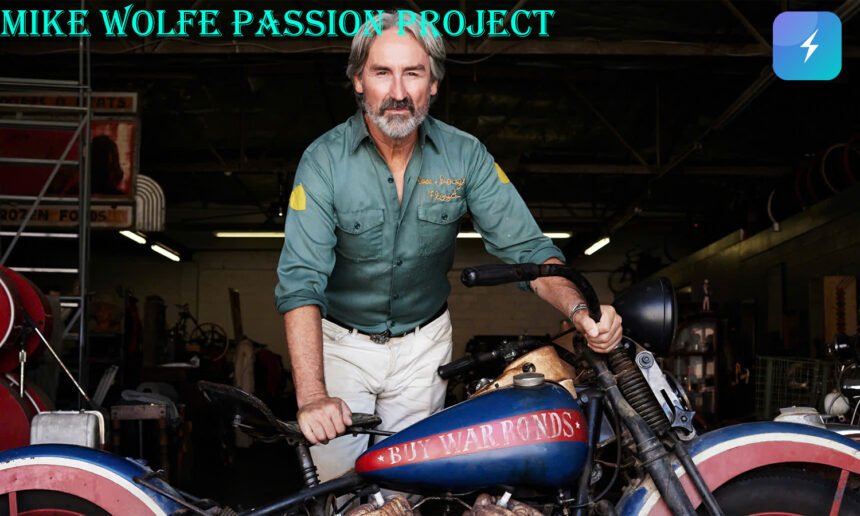
Mike Wolfe is widely recognized as the creator and longtime face of American Pickers, the HISTORY series built around discovering forgotten antiques, vintage motorcycles, advertising signs, automobiles, and other pieces of American history. Yet Wolfe’s interest in the past goes beyond collecting objects. Over the years, historic preservation has become an important part of his work, particularly the restoration and reuse of old buildings in small American towns. HISTORY describes preserving small-town America as Wolfe’s “full-time passion” outside his family, specifically noting his interest in finding older buildings that can be reclaimed, restored, and given new life.
That background helps explain the growing search interest around the phrase “Mike Wolfe Passion Project.” It does not appear to refer to one formally branded initiative with a single launch date, membership system, or official program structure. Instead, the phrase is best understood as describing Wolfe’s broader preservation work and, in some coverage, particular projects such as Columbia Motor Alley and the restoration of a former Esso service station in Columbia, Tennessee.
The common thread is simple: Wolfe sees value in buildings, vehicles, objects, and Main Streets that might otherwise be overlooked. Rather than treating preservation as keeping history behind glass, his projects often try to make historic places useful again.
What Is the Mike Wolfe Passion Project?
The Mike Wolfe Passion Project can best be described as Wolfe’s continuing effort to preserve pieces of American history through collecting, restoration, adaptive reuse, storytelling, and investment in historic properties.
There is an important distinction to make. Public sources do not establish “Mike Wolfe Passion Project” as the official name of one company, nonprofit organization, app, technology platform, or single development. The wording is often used online to describe his restoration activities collectively or to label a particular project that reflects his interests.
The most authoritative description of Wolfe’s broader mission comes from HISTORY. His official profile explains that he searches for objects that help fill gaps in everyday American history and that his larger passion involves finding older buildings across the Midwest and mid-South that can be reclaimed and restored.
This makes historic preservation the strongest verified interpretation of the term. Wolfe’s work connects several interests: vintage transportation, architecture, antiques, Main Street culture, local history, and small-town redevelopment.
How American Pickers Connects to Wolfe’s Preservation Work
American Pickers provides useful context for understanding why restoring buildings is a natural extension of Wolfe’s career.
The HISTORY series follows pickers traveling across the United States looking for overlooked items in barns, garages, basements, yards, and collections. The objects matter partly because of their monetary or collectible value, but storytelling is also central to the format. HISTORY describes the program as involving the restoration of forgotten relics while meeting people and learning the stories connected to their belongings.
Wolfe’s official biography makes the connection even clearer. He has been interested in finding discarded or forgotten objects since childhood and particularly values pieces that carry stories about everyday American life.
Historic buildings apply essentially the same philosophy on a larger scale. An old motorcycle can reveal something about transportation history. A faded advertising sign can preserve a piece of commercial history. Likewise, a former automobile dealership, gas station, storefront, or Main Street building can preserve the architectural and economic history of the community around it.
Seen this way, Wolfe’s preservation projects are less of a departure from American Pickers than an expansion of the same idea.
Columbia, Tennessee, and the Heart of the Project
Columbia, Tennessee, has become particularly important when discussing Mike Wolfe’s historic-preservation work.
Located south of Nashville, Columbia has a traditional downtown and a strong connection to regional history. Wolfe has been involved with multiple properties and restoration efforts there, with transportation history becoming an especially visible theme.
One reason Columbia fits Wolfe’s interests is that historic buildings can remain part of everyday life instead of becoming isolated museum pieces. Older structures can potentially accommodate businesses, events, hospitality, workshops, or gathering spaces while retaining architectural features and stories from their earlier lives.
Wolfe has publicly discussed his interest in Columbia’s transportation history. Reporting on one of his local projects quoted him discussing his enthusiasm for preserving the area’s automotive heritage and noted that he had previously restored properties in Iowa and Nashville as well.
Columbia therefore represents more than a convenient location for Wolfe. It provides a real-world setting where his interests in automobiles, old buildings, community spaces, and preservation overlap.
Columbia Motor Alley: A Major Example of Wolfe’s Vision
One of the most recognizable pieces of Wolfe’s Columbia work is Columbia Motor Alley.
The property is associated with a former 1947 Chevrolet dealership, connecting it directly with the automotive history Wolfe has collected and promoted for years. Recent coverage describes Wolfe as having worked to restore the dealership, while his Antique Archaeology website continues to feature Columbia Motor Alley as one of his ventures.
Its significance goes beyond preserving an old facade. The automotive identity of the property remains central to how the site is presented. Vintage cars, motorcycles, signs, pumps, and other transportation-related elements naturally fit into an environment that once served the automobile business.
Community events have also used the area. Local coverage of Columbia Cars & Coffee, for example, has identified Columbia Motor Alley as the center of gatherings involving classic vehicles, music, vendors, and visitors.
This illustrates an important element of Wolfe’s approach: preservation can work best when people are invited to interact with a place.
Instead of restoring an old dealership simply to make it look historic, a property can retain its history while supporting new activity.
The Restored Esso Station in Columbia
Another project closely associated with searches for the “Mike Wolfe Passion Project” is Wolfe’s restoration of an old Esso service station in downtown Columbia.
Plans for the property were publicly discussed well before the finished restoration attracted widespread attention. In 2023, NewsChannel 5 reported that Wolfe had presented restoration plans to Columbia’s Historic Zoning Commission. The building was approximately 900 square feet, and proposed features included green space, a fire pit, and non-functioning vintage gas pumps.
In May 2025, Wolfe revealed the transformed property publicly. He explained that he wanted to turn what had been an ignored space into somewhere the community could gather and credited Living Exo with helping realize his vision.
This project is particularly useful for understanding adaptive reuse.
The objective was not simply to make the building look new. At the same time, the station did not need to return to operating as a conventional gas station. Its transportation history could remain visually recognizable while the property gained a different modern purpose.
That balance between preservation and usefulness is at the center of many successful historic-building projects.
Why Transportation History Matters So Much
Cars, motorcycles, bicycles, gas stations, dealerships, and roadside culture appear repeatedly throughout Wolfe’s work.
That is not surprising. Wolfe has long been associated with vintage motorcycles and transportation-related antiques. His public profile describes him as someone searching for historically meaningful objects, while his businesses and collections regularly feature motorcycles, bicycles, automobiles, signs, and related memorabilia.
Columbia Motor Alley and the Esso station take that interest beyond individual collectibles. Instead of preserving only a motorcycle or a gas pump, these projects preserve environments associated with America’s transportation history.
The connection remains relevant today. In 2026, Cheekwood Estate & Gardens announced that Wolfe would receive the Lambert Cup, an award recognizing passion for automotive history, preservation, and collecting. The announcement identified him as the owner of Columbia Motor Alley.
That provides current, independent confirmation that automotive preservation remains a meaningful part of Wolfe’s public work.
Two Lanes Guesthouse and Experiencing Americana
Hospitality provides another way Wolfe has translated his interest in history into a practical experience.
The Two Lanes Guesthouse concept has allowed visitors to stay in spaces shaped by Wolfe’s vintage-Americana aesthetic. A Columbia version was created in an approximately 1,100-square-foot loft inside a historic building dating to 1857. The interior incorporated vintage pieces, including items connected with Wolfe’s collecting work.
The idea is notable because antiques are not presented only as merchandise. They become part of an environment people can inhabit.
Wolfe has also promoted a Two Lanes Guesthouse in Le Claire, Iowa, close to the Mississippi River and his Antique Archaeology location. In 2025, he publicly encouraged visitors to stay there and explore the surrounding Midwest region.
Together, these projects demonstrate another side of preservation: heritage tourism.
Visitors may arrive because they recognize Wolfe from television, but the experience can also introduce them to historic downtowns, architecture, independent businesses, regional landscapes, and vintage design.
Antique Archaeology and the Business Side of Preservation
Any complete explanation of Wolfe’s preservation activities should also mention Antique Archaeology.
The business has long provided a commercial outlet for Wolfe’s picking. Its current website features antiques and merchandise while also directing visitors toward Columbia Motor Alley and Two Lanes Guesthouse.
This highlights the relationship between preservation and commerce.
Historic preservation requires resources. Buildings need structural work, maintenance, utilities, insurance, and ongoing management. Vintage objects also need storage, conservation, documentation, transportation, or restoration.
Commercial activity can therefore help historic places remain active rather than abandoned.
At the same time, it is important not to overstate the public evidence. Wolfe’s projects should not automatically be described as charitable preservation programs. Some are private businesses, commercial properties, hospitality ventures, or personal investments that also support preservation goals.
Recognizing both sides gives a more accurate picture.
How the Mike Wolfe Preservation Approach Works
There is no published universal formula for a “Mike Wolfe Passion Project.” However, his publicly documented projects reveal a recognizable pattern.
First comes identification. Wolfe is drawn to places or objects that possess historic character, particularly when they relate to transportation, commerce, craftsmanship, or everyday American life.
The next stage is preservation and restoration. Depending on the property, that can mean retaining recognizable architectural elements while repairing or adapting the structure for modern use.
Then comes curation. Vintage motorcycles, signs, automobiles, furniture, artwork, or industrial objects can reinforce the story of the building.
Finally, the property needs a contemporary purpose. That may involve retail, accommodation, events, food and drink, workshops, or a community gathering function.
The result is not necessarily a historically exact recreation. It is often closer to adaptive reuse: preserving the identity of a historic place while making it functional in the present.
Community Value and Small-Town Revitalization
One of the most meaningful aspects of Wolfe’s preservation philosophy is its connection with Main Street communities.
A restored building can affect more than its owner. Visitors to one destination may eat at nearby restaurants, visit independent shops, attend events, book accommodation, or explore other local attractions.
Historic buildings also help communities retain a visual identity. If every older structure is demolished and replaced with standardized development, a downtown can gradually lose the architectural qualities that distinguish it from anywhere else.
Wolfe’s HISTORY biography directly connects his preservation interest with breathing new life into Main Streets.
The Esso station restoration provides a practical example. Wolfe specifically described wanting the formerly ignored space to become somewhere the community could gather for years.
That does not prove that every restoration automatically produces broad economic revitalization. Such outcomes depend on many businesses, residents, local policies, investors, and community organizations. But Wolfe’s projects demonstrate how private preservation can contribute to a larger downtown-revival effort.
Storytelling Is as Important as Restoration
Physical restoration is only one part of Wolfe’s approach. Storytelling has always been equally important.
American Pickers succeeded partly because an object was rarely presented as just an object. Viewers learned where it came from, who used it, why it mattered, and how it reflected a particular period of American life.
The same principle applies to historic buildings.
An old dealership becomes more interesting when visitors understand its relationship with automobile culture. A service station becomes more meaningful when its pumps, architecture, and location are interpreted as parts of an earlier transportation landscape.
This storytelling dimension can also make preservation more accessible. Someone who has little interest in architectural terminology may still connect emotionally with an old motorcycle shop, roadside sign, gas pump, or Main Street storefront.
Wolfe’s projects effectively use familiar pieces of Americana as entry points into broader conversations about history.
Does the Project Use AI, Automation, or Advanced Technology?
There is no reliable public evidence that artificial intelligence, proprietary automation, blockchain systems, specialized software, or other advanced digital technology forms a central part of the Mike Wolfe Passion Project.
Claims suggesting otherwise should be treated cautiously unless supported by Wolfe or an authoritative source.
These projects are primarily physical. They involve buildings, historic objects, design, construction, restoration, retail, hospitality, automotive culture, events, and community spaces.
Modern businesses naturally use websites, online booking, e-commerce, social media, and other digital tools. Antique Archaeology, for example, maintains an online storefront, while guesthouse properties can be marketed and booked digitally. But those ordinary digital functions should not be confused with a dedicated technology platform.
For readers researching this keyword, this distinction matters. “Mike Wolfe Passion Project” is fundamentally a preservation and lifestyle topic, not an AI product or software service.
Security, Privacy, and Integrations
For the same reason, conventional software categories such as API integrations, data encryption, account permissions, cloud infrastructure, and user-data processing are largely irrelevant to the overall topic.
Individual businesses connected with Wolfe may operate websites, e-commerce systems, reservation services, or social-media accounts. Those platforms have their own privacy and security practices.
However, no verified evidence shows that the broader “passion project” maintains a centralized digital account system or collects user information under a separate technological platform.
Visitors interested in booking accommodation, purchasing merchandise, or attending an event should therefore review the policies of the specific service they are using rather than assuming that all Wolfe-related ventures share one system.
Benefits of Wolfe’s Preservation Model
The clearest benefit is the preservation of physical history. Once an old building is demolished, much of its original architectural and cultural context cannot be recovered.
Adaptive reuse offers an alternative. A structure can retain its historical character while serving contemporary needs.
There are also educational benefits. Vintage signs, automobiles, motorcycles, buildings, and furnishings can introduce visitors to history in a tangible way.
Tourism is another potential advantage. Wolfe’s television audience gives his projects unusual visibility, which can encourage fans to visit places such as Le Claire or Columbia and discover surrounding businesses.
Finally, there is an environmental argument for reuse. Preserving and adapting an existing building can, depending on the project, avoid some of the material waste associated with demolition and complete replacement. The exact environmental impact varies from building to building, so broad sustainability claims should not be made without project-specific data.
Limitations and What Remains Unknown
Several details about the Mike Wolfe Passion Project remain unclear because there is no single official project under that exact name.
There is no verified master budget covering all of Wolfe’s preservation activities. There is no confirmed completion date for his overall preservation mission, nor would such a date necessarily make sense for an ongoing interest.
Likewise, there is no authoritative public list identifying every property Wolfe owns, has restored, or may restore in the future.
Some online articles attach specific costs, investment totals, economic impacts, or future plans to Wolfe’s work. Such numbers should not be repeated unless they can be traced to reliable property records, official statements, government documents, or credible reporting.
It is also important to separate Wolfe’s personal projects from broader redevelopment occurring around Columbia. Downtown revitalization involves many property owners, businesses, government bodies, preservation organizations, residents, and investors. Wolfe is a visible participant, but it would be inaccurate to attribute every local improvement to him.
How to Verify Information About Mike Wolfe’s Projects
Readers researching Wolfe’s current activities should prioritize primary and well-established sources.
His official HISTORY biography is useful for understanding his background and preservation philosophy. Antique Archaeology’s official website provides information about current Wolfe-related ventures and links to Columbia Motor Alley and Two Lanes Guesthouse. Local government records and historic-zoning documents can help confirm proposed building work.
Established local news organizations are particularly valuable for development projects because they can report zoning approvals, construction plans, business openings, and statements from community members.
Dates also matter. Historic restoration projects can change significantly between the planning stage and completion. An article written while permits are being reviewed may no longer describe the current condition of the property.
What Could Come Next?
Wolfe’s future preservation activities cannot be predicted with certainty.
However, his long-running interests provide some reasonable possibilities. Historic buildings, transportation culture, vintage motorcycles, automobiles, antiques, Main Street communities, and back-road travel have remained consistent themes throughout his public career.
His continued association with Columbia Motor Alley and recognition for automotive preservation in 2026 suggest that these interests remain active.
Future projects could therefore continue combining historic structures with automotive culture, hospitality, retail, events, or community-oriented uses. That is a possibility based on his established pattern, not a confirmed development plan.
The larger significance of Wolfe’s work may ultimately be less about any individual property and more about the idea it demonstrates: an old building does not have to choose between becoming a museum and being demolished. With careful adaptation, it can preserve its story while gaining a new function.
Bottom Line
The Mike Wolfe Passion Project is best understood not as one formally defined project, but as a broader preservation philosophy reflected in Mike Wolfe’s work with historic buildings, antiques, transportation heritage, hospitality, and small-town communities.
Wolfe’s career on American Pickers established his fascination with objects that tell stories about ordinary American life. His work beyond television extends that idea from individual objects to entire places.
Columbia Motor Alley demonstrates how an old automotive property can maintain its transportation identity while supporting present-day activity. The restored Esso station shows how an overlooked service station can be adapted into a community-oriented space. Two Lanes Guesthouse demonstrates how historic architecture and vintage objects can become an immersive hospitality experience.
What should not be done is turn the phrase into something it is not. There is no verified evidence that the Mike Wolfe Passion Project is a single technology company, AI platform, subscription service, or centrally managed preservation program.
Its real story is simpler and more interesting: Wolfe has spent years arguing through his work that old things still have value. Sometimes that means rescuing a motorcycle or sign from a barn. Increasingly, it also means recognizing that the building around those objects may be worth saving too.
Frequently Asked Questions
What is the Mike Wolfe Passion Project?
The phrase generally refers to Mike Wolfe’s historic-preservation activities, particularly his efforts to restore older buildings, preserve transportation history, celebrate Americana, and support renewed use of historic spaces. It is not clearly established as the formal name of one single organization or program.
Is Columbia Motor Alley Mike Wolfe’s passion project?
Columbia Motor Alley is one of the strongest examples associated with the phrase. Wolfe has worked to restore the former 1947 Chevrolet dealership in Columbia, Tennessee, and the property reflects his interests in automotive history and preservation.
What happened to Mike Wolfe’s old Esso gas station?
Wolfe purchased a former Esso station in downtown Columbia and pursued a restoration that retained its vintage service-station character while creating a modern gathering space. Plans included landscaping, a fire feature, and decorative vintage pumps, and Wolfe publicly revealed the transformed property in 2025.
Why is Mike Wolfe interested in historic buildings?
Wolfe’s official HISTORY biography says preserving small-town America is one of his major passions. It specifically describes his interest in finding older buildings in the Midwest and mid-South that can be reclaimed, restored, and reinvigorated.
What is Two Lanes Guesthouse?
Two Lanes Guesthouse is a hospitality concept associated with Wolfe that combines historic settings with curated vintage-Americana decor. A Columbia guesthouse occupied a restored loft in an 1857 building, while Wolfe has also promoted a Two Lanes Guesthouse in Le Claire, Iowa.
Does Mike Wolfe’s passion project use AI or advanced technology?
There is no credible public evidence showing that AI or proprietary advanced technology is a central part of the project. Wolfe’s documented activities primarily concern physical restoration, historic buildings, vintage objects, automobiles, motorcycles, hospitality, retail, and community spaces.
Is Mike Wolfe still involved in automotive preservation?
Yes. Columbia Motor Alley remains associated with Wolfe, and in 2026 Cheekwood Estate & Gardens announced him as the recipient of the Lambert Cup for his passion for automotive history, preservation, and collecting.