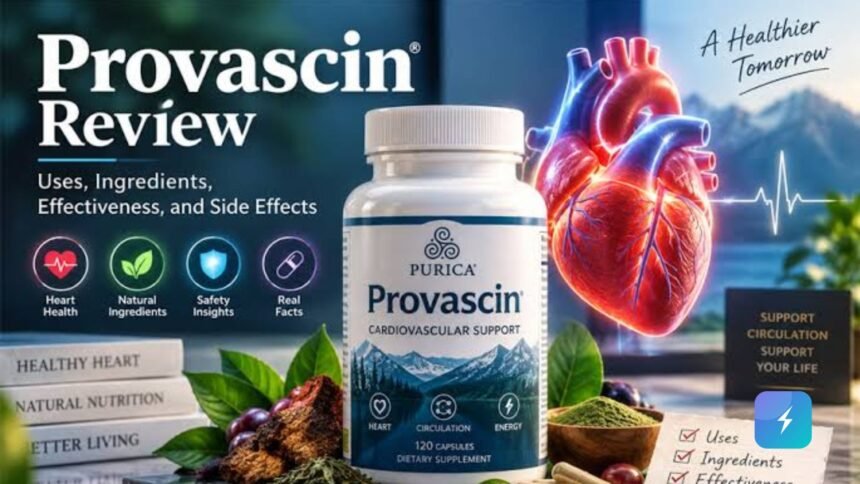
Provascin is a name associated with a cardiovascular-support supplement historically sold under the PURICA brand. Interest in Provascin has grown because online information about it is surprisingly inconsistent. Some pages describe it as a heart-health supplement, while others make it sound like a prescription cardiovascular medicine. The strongest available documentation, however, identifies the best-known Provascin product as a dietary or natural-health supplement rather than a prescription drug. U.S. trademark records list PROVASCIN in connection with dietary supplements and identify The Nutraceutical Medicine Company Inc. as the owner.
Historical retailer listings show that PURICA Provascin was sold in capsule form and combined several nutritional and botanical ingredients, including L-carnitine, alpha-ketoglutaric acid, Chaga, Coenzyme Q10, betaine hydrochloride, alpha-lipoic acid, grape seed extract, and green tea extract. It was marketed mainly around cardiovascular health, circulation, antioxidant activity, energy metabolism, and related wellness goals.
That description needs an important qualification: marketing a supplement for cardiovascular support is not the same as proving that it prevents or treats cardiovascular disease. Research exists for several ingredients individually, but evidence about an individual ingredient cannot automatically establish the effectiveness of the complete Provascin formula.
This guide separates documented product information from historical marketing claims and examines what consumers should know about Provascin, its ingredients, possible mechanisms, evidence, safety, availability, and unanswered questions.
What Is Provascin?
The most clearly documented Provascin is PURICA Provascin, a multi-ingredient supplement that was marketed for cardiovascular and circulatory support. Historical retailers offered the product in capsule form, including 120- and 240-capsule packages.
Provascin should not be automatically classified as a prescription heart medication simply because its name sounds pharmaceutical. The U.S. trademark record for PROVASCIN describes the goods as dietary supplements, specifically “anti-catabolic supplements,” rather than identifying the product as a prescription cardiovascular drug. The trademark was filed in the United States in 2003 and later registered, although trademark dates should not be interpreted as proof of the product’s exact commercial launch date.
Historical commercial evidence confirms that the product was available by the mid-2010s. A Canadian retailer discussed PURICA Provascin as a new cardiovascular-health product in March 2015, while later pharmacy material continued to describe it as a PURICA supplement for heart-health support.
The exact development history, original launch date, and complete history of formulation changes are not clearly documented in reliable public sources. Those details should therefore remain classified as unknown rather than filled in with assumptions.
What Was Provascin Designed to Support?
Historical retailers promoted Provascin as a broad-spectrum cardiovascular formula rather than a single-purpose nutrient. Product descriptions associated it with heart and blood-vessel support, antioxidant activity, healthy glucose metabolism, cholesterol maintenance, muscle tissue, circulation, and other aspects of cardiovascular wellness.
Those claims need careful interpretation.
A retailer saying that a product is “designed to support” cholesterol or cardiovascular health is describing its intended use or marketing position. It does not demonstrate that the supplement has been clinically proven to lower cholesterol, prevent heart attacks, treat hypertension, or reverse cardiovascular disease.
This distinction is especially important for anyone searching Provascin because of an existing medical condition. Diagnosed high blood pressure, abnormal cholesterol, diabetes, heart disease, chest pain, or circulation problems require appropriate medical evaluation and should not be self-treated by substituting an old supplement for prescribed care.
Provascin Ingredients and Historical Formula
One useful aspect of the historical PURICA product is that archived retailer information provides specific ingredient quantities rather than simply referring to a proprietary cardiovascular blend.
According to historical product listings, each capsule contained:
| Ingredient | Historical Amount Per Capsule |
|---|---|
| L-Carnitine | 188 mg |
| Alpha-ketoglutaric acid | 125 mg |
| Certified organic micronized Chaga | 125 mg |
| Coenzyme Q10 (CoQ10) | 38 mg |
| Betaine hydrochloride | 31 mg |
| DL-alpha-lipoic acid | 13 mg |
| Grape seed extract | 9 mg |
| Green tea extract | 9 mg |
Historical listings also named plant-source magnesium stearate, microcrystalline cellulose, and hypromellose as non-medicinal ingredients.
These amounts are useful for identifying the historical PURICA formula, but they should not be used to identify every product currently advertised under the Provascin name. If a seller offers Provascin today, the actual package label, manufacturer, ingredient amounts, expiration date, and regulatory information matter more than an archived webpage.
L-Carnitine
L-carnitine is involved in cellular energy metabolism. It helps transport long-chain fatty acids into mitochondria, where they can be oxidized to produce energy. The NIH Office of Dietary Supplements notes that much of the body’s carnitine is concentrated in heart and skeletal muscle.
This biological role helps explain why L-carnitine appears in cardiovascular and exercise-related supplements.
However, cardiovascular research involving carnitine has produced mixed results. Studies have investigated it in areas including cardiovascular disease, heart failure, and peripheral artery disease, but the NIH notes that more research is needed to fully understand its cardiovascular effects. Some research has also raised questions about carnitine metabolism and trimethylamine-N-oxide, or TMAO, which adds further complexity to simple claims that more carnitine is necessarily better for heart health.
Coenzyme Q10
Coenzyme Q10 is naturally present in the human body and participates in processes connected with cellular energy. It is found at relatively high levels in organs including the heart.
CoQ10 is widely promoted in cardiovascular supplements, but the clinical evidence is more nuanced than advertising sometimes suggests. The National Center for Complementary and Integrative Health states that studies investigating CoQ10 for preventing heart disease have produced inconclusive results. Research on heart failure is also described as inconclusive, and the available evidence suggests CoQ10 probably does not have a meaningful effect on blood pressure.
Therefore, the presence of CoQ10 makes biological sense in a cardiovascular-oriented supplement, but it does not prove Provascin itself prevents or treats cardiovascular disease.
Chaga Mushroom
The historical formula contained certified organic micronized Chaga. Chaga is a fungus commonly used in traditional and modern wellness products and is frequently promoted for its naturally occurring compounds and antioxidant properties.
Its inclusion helped position Provascin as a combination of nutritional compounds and botanical ingredients rather than a conventional medication.
The key evidence issue remains the same: laboratory findings or studies of Chaga alone cannot establish that the complete Provascin formula produces a clinically meaningful cardiovascular benefit in humans.
Alpha-Ketoglutaric Acid
Alpha-ketoglutarate is an intermediate involved in normal cellular metabolism, including the citric acid cycle. Its presence fits the metabolic and energy-oriented design of the historical formula.
Nevertheless, its physiological importance does not mean supplementation with the amount contained in Provascin has been demonstrated to prevent cardiovascular disease. Biological function and proven therapeutic effectiveness are different standards of evidence.
Alpha-Lipoic Acid
Alpha-lipoic acid participates in cellular processes and is often discussed for its antioxidant properties and role in energy metabolism.
Historical Provascin marketing connected the broader formula with antioxidant and glucose-metabolism support.
Again, ingredient-level research needs to be separated from finished-product evidence. Even when an individual compound has scientifically established biological functions, that does not demonstrate that a specific multi-ingredient supplement produces a particular medical outcome.
Grape Seed and Green Tea Extracts
Grape seed and green tea extracts supplied additional plant-derived compounds to the formula. PURICA-related historical marketing grouped grape seed and green tea extracts within an antioxidant-focused component.
Green tea is particularly important from an evidence and safety perspective. NCCIH reports that studies of green tea products have found small reductions in total and LDL cholesterol, although results and formulations vary. Concentrated green tea extracts also carry precautions that ordinary green tea consumption may not.
How Was Provascin Supposed to Work?
Provascin did not depend on one identified pharmaceutical mechanism. Instead, the historical formulation appears to have followed a multi-pathway nutritional strategy.
L-carnitine and CoQ10 were associated with cellular energy processes. Alpha-lipoic acid and botanical extracts were included in an antioxidant-oriented formula. Chaga added another natural-health component, while other ingredients contributed to the broader metabolic positioning of the product.
This provides a reasonable explanation of the formulation concept.
What cannot be responsibly claimed is that all eight ingredients automatically create a clinically proven synergistic cardiovascular treatment. “Synergy” is commonly used in supplement marketing, but proving a synergistic medical effect requires direct research on the combination rather than simply demonstrating that individual ingredients perform different biological functions.
No strong published clinical evidence located for this review establishes the historical complete Provascin formula as a proven treatment for cardiovascular disease.
What Does Scientific Evidence Say About Provascin?
The biggest limitation surrounding Provascin is the difference between ingredient research and product-specific clinical evidence.
L-carnitine has been investigated scientifically. CoQ10 has been investigated scientifically. Green tea extracts and various antioxidant compounds have also been studied.
But none of those facts alone constitutes a clinical trial of Provascin.
For a multi-ingredient formula to support strong claims about treating or preventing disease, researchers would ideally study the exact formula, doses, target population, outcomes, safety profile, and comparison group under controlled conditions.
The available public information does not establish that level of evidence for Provascin.
This does not prove that the historical supplement had no physiological effects. It simply means that its effectiveness should not be presented with greater certainty than the evidence supports.
Can Provascin Lower Blood Pressure or Cholesterol?
Provascin should not be described as a proven treatment for hypertension.
Some of its ingredients have been researched in cardiovascular contexts, but even commonly discussed ingredients do not necessarily produce the expected result. NCCIH, for example, says the limited evidence available suggests CoQ10 probably does not meaningfully affect blood pressure.
Similarly, green tea extracts have shown modest effects on total and LDL cholesterol in some research, but that finding cannot be converted into a claim that Provascin itself lowers cholesterol.
The dose, formulation, population, duration, and combination of ingredients all matter.
Anyone with high blood pressure or abnormal cholesterol should therefore view Provascin as a historically marketed supplement—not as an alternative to diagnosis, monitoring, lifestyle management, or evidence-based medication when medically indicated.
Provascin Dosage: What Did Historical Labels Recommend?
Archived retailers reported historical directions of 3–4 capsules daily for what the product described as preventive use and 6–8 capsules daily for existing cardiovascular conditions.
These directions are included here only as historical product information.
They should not be interpreted as a current medical recommendation.
This is particularly important because the product appears to be discontinued or no longer carried by major retailers, and an old package may be expired or may not reflect current regulatory guidance. Furthermore, recommending a supplement for an “existing cardiovascular condition” requires much more caution than ordinary wellness supplementation because people with cardiovascular disease commonly take medications that can interact with supplements.
Provascin Side Effects, Interactions, and Safety
There is no simple universal side-effect profile for a multi-ingredient supplement such as Provascin. Each component can have its own precautions, and interactions become especially important for people using prescription medications.
Historical retailer information advised consumers to consult a healthcare practitioner in circumstances including pregnancy or breastfeeding, liver disorders, iron deficiency, diabetes, kidney disease, seizure disorders, autoimmune conditions, use of immunosuppressants, and use of blood-pressure or blood-thinning medications.
Modern ingredient information reinforces the need for caution.
NCCIH reports that CoQ10 can interact with warfarin and insulin. Mild digestive problems or insomnia can also occur.
Concentrated green tea extract may cause nausea, constipation, abdominal discomfort, and increased blood pressure. Rare cases of liver injury have also been reported. Green tea can interact with medicines, including nadolol and atorvastatin.
L-carnitine can cause gastrointestinal effects at higher supplemental amounts, and medication interactions and individual health conditions also need consideration.
These considerations make self-treatment particularly inappropriate for someone already managing heart disease, hypertension, diabetes, abnormal cholesterol, or another chronic condition.
Is Provascin Still Available?
Current availability is one of the most important practical questions.
Historical retailer pages remain online, but that does not mean the original product is still being actively manufactured or normally distributed.
National Nutrition currently states that it no longer carries PURICA Provascin in the historical 120-capsule format, and its 240-capsule listing is also marked as no longer carried.
Vitamart also retains historical product information.
Taken together, the evidence suggests that the original PURICA Provascin has been discontinued or is at least no longer routinely available through these established retailers. A precise official discontinuation date and reason could not be reliably verified.
Consumers should therefore be particularly careful with online listings claiming to sell Provascin today.
How to Evaluate a Provascin Product Before Buying
If you encounter a product currently using the Provascin name, do not assume that it is identical to the historical PURICA formula.
First confirm the exact manufacturer. Then compare the full ingredient list and amounts with the actual package label rather than relying on a blog article or seller headline. Check the expiration date, lot information, safety seal, seller reputation, storage history, warnings, and applicable regulatory information.
An old bottle is not necessarily a useful substitute for a currently manufactured supplement. Ingredients can degrade, storage conditions may be unknown, and expired products should not be used simply because the formula was once commercially available.
Consumers should also be skeptical of listings promising that Provascin can “cure,” “reverse,” or definitively treat serious cardiovascular conditions without high-quality supporting evidence.
Does Provascin Use AI, Automation, or Digital Technology?
No credible evidence reviewed indicates that Provascin involved artificial intelligence, software, automation, apps, connected devices, digital monitoring, or technology integrations.
It was a capsule-based nutritional supplement.
This matters because generic online articles sometimes force technology-related sections into topics where they do not belong. There is no meaningful AI or software component to explain for the documented PURICA Provascin product.
Similarly, there are no relevant API integrations, digital privacy systems, cybersecurity features, or user-data collection processes associated with taking the historical supplement.
Verified Facts vs. Unconfirmed Provascin Claims
Several points can be supported reasonably well by public records.
Provascin existed as a supplement associated with PURICA. Trademark records connect PROVASCIN with The Nutraceutical Medicine Company Inc. and dietary supplements. Historical retailers documented the formula, capsule formats, ingredients, quantities, directions, and product warnings.
Historical commercial records also show that it was promoted around cardiovascular and metabolic support.
However, several stronger claims remain unsupported or insufficiently verified.
There is no basis in the evidence reviewed to call Provascin an FDA-approved prescription cardiovascular medication. Strong product-specific clinical evidence demonstrating that the complete formula prevents heart disease, treats hypertension, lowers cholesterol to a clinically meaningful degree, or replaces conventional cardiovascular treatment was not identified.
The exact original launch date, exact discontinuation date, reason for discontinuation, and full clinical development history also remain unclear.
Keeping those categories separate produces a much more accurate picture than repeating promotional descriptions as established medical facts.
Future Possibilities for Provascin
Because the historical product appears to have left normal retail circulation, predicting a future for Provascin itself would be speculative.
PURICA or another authorized owner could theoretically revive, reformulate, or replace a cardiovascular supplement, but no such future should be presented as fact without an official announcement.
The broader idea behind Provascin—a multi-ingredient cardiovascular wellness formula—remains common in the supplement industry. Future products in this category could benefit from stronger transparency, clearly standardized ingredients, independent quality testing, and controlled clinical research on the complete formulation rather than relying mainly on evidence from individual ingredients.
For consumers, those improvements would make it easier to distinguish scientifically supported benefits from plausible but unproven marketing claims.
Bottom Line
Provascin is best understood as a historical PURICA dietary or natural-health supplement designed and marketed for broad cardiovascular, circulation, metabolic, and antioxidant support. The documented formula combined L-carnitine, alpha-ketoglutaric acid, micronized Chaga, CoQ10, betaine hydrochloride, alpha-lipoic acid, grape seed extract, and green tea extract.
Several of these ingredients have legitimate biological functions and have been individually studied. However, that evidence should not be mistaken for proof that the complete Provascin formula prevents or treats cardiovascular disease.
The product also appears to be discontinued or no longer routinely carried by retailers that historically sold it. Anyone encountering Provascin today should verify exactly what product is being offered rather than assuming an unfamiliar listing represents the original PURICA formula.
Most importantly, Provascin should not replace prescribed medication, professional cardiovascular assessment, or evidence-based treatment. People with heart disease, high blood pressure, diabetes, abnormal cholesterol, liver or kidney conditions, or those taking medications should discuss supplement use with an appropriate healthcare professional.
Frequently Asked Questions About Provascin
What is Provascin?
Provascin is best documented as a multi-ingredient dietary supplement historically sold under the PURICA brand. It was marketed mainly for cardiovascular, circulation, antioxidant, and metabolic support rather than as a prescription medication.
What ingredients were in Provascin?
The historical formula contained L-carnitine, alpha-ketoglutaric acid, certified organic micronized Chaga, CoQ10, betaine hydrochloride, DL-alpha-lipoic acid, grape seed extract, and green tea extract.
Is Provascin a prescription heart medicine?
The documented PURICA Provascin is identified through trademark and retail records as a dietary or natural-health supplement, not a prescription cardiovascular medicine.
Does Provascin lower blood pressure?
There is insufficient product-specific clinical evidence to state that Provascin reliably lowers blood pressure. It should not be used as a substitute for prescribed hypertension treatment.
Is Provascin still available?
Historical product pages remain online, but major retailer listings state that PURICA Provascin is discontinued or no longer carried. This means consumers should carefully verify any current listing using the Provascin name.
Is Provascin safe?
Safety depends on the individual’s health, medications, dose, and exact product. Historical warnings included precautions for people taking blood thinners or blood-pressure medicines and for those with diabetes, liver or kidney disease, seizure disorders, autoimmune conditions, and several other situations.
Is Provascin clinically proven to treat cardiovascular disease?
Available evidence does not establish the complete Provascin formula as a clinically proven treatment for cardiovascular disease. Research on ingredients such as L-carnitine and CoQ10 is not equivalent to clinical evidence for the finished Provascin product.
Read More Topics:
Trupeek Com: What It Is, What the Website Offers, and What Users Should Know
Brasssmile Com: What It Is, What the Website Covers, and What Readers Should Know
Kinervus: A Complete Guide to the Belgian Physiotherapy and Rehabilitation Practice