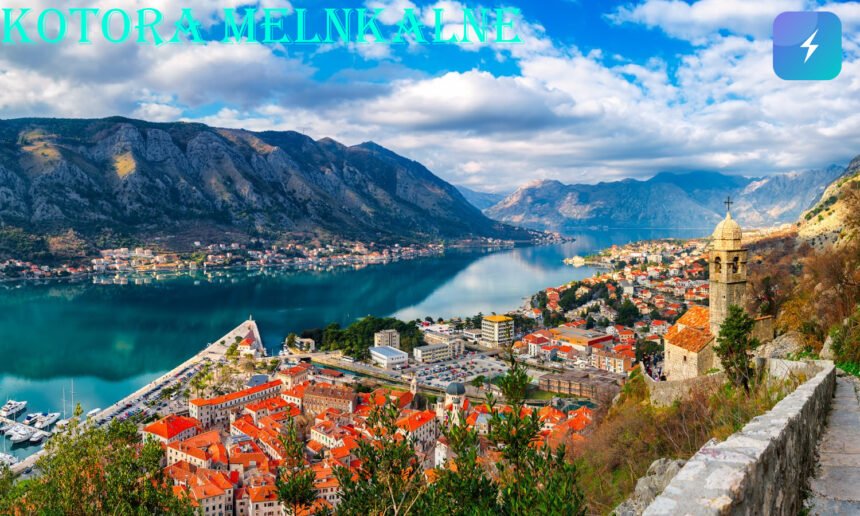
The phrase Kotora Melnkalne can be confusing when it first appears in search results. It may sound like the name of an unfamiliar destination, a hidden town, or even a newly popular travel spot. The available geographical evidence, however, points to a much simpler explanation: Kotora Melnkalne refers to Kotor in Montenegro, rather than to a separate city or attraction.
The strongest evidence comes from the National Library of Latvia’s geographical-name database, which has an authority record for “Kotora (Melnkalne)” and associates it with the English geographical forms “Kotor (Monténégro)” and “Montenegro–Kotor.” Latvian-language travel and accommodation pages also use “Kotora” for Kotor and “Melnkalne” for Montenegro.
Understanding that distinction opens the door to the real subject behind the keyword: Kotor, one of Montenegro’s most historically significant coastal destinations. Set beside the Bay of Kotor and surrounded by steep mountains, the city is known for its fortified historic center, churches, palaces, maritime heritage, narrow stone streets, and dramatic relationship between architecture and landscape. Its wider cultural region has been recognized by UNESCO since 1979.
This guide explains what Kotora Melnkalne means, where Kotor is located, why the city is important, what visitors can see and do, and what should be verified before planning a trip.
What Does Kotora Melnkalne Mean?
Kotora Melnkalne is best understood as a Latvian geographical reference to Kotor, Montenegro. It should not be treated as the official name of another town, resort, neighborhood, company, or tourist attraction.
The National Library of Latvia maintains an entry titled “Kotora (Melnkalne).” The database gives “Melnkalne–Kotora” as an alternative form and lists English equivalents connected with Kotor in Montenegro. This is particularly useful because it provides an authoritative explanation for a phrase that has sometimes been presented less accurately elsewhere on the internet.
Latvian-language accommodation listings provide additional real-world evidence. Addresses for properties in Kotor can appear with wording such as “Kotora, Melnkalne,” demonstrating that these terms are being used in a geographical and linguistic context rather than to identify an unknown destination.
For practical purposes, English-speaking travelers should search for Kotor, Montenegro when using maps, looking for hotels, researching transport, or consulting official tourism information.
Is Kotora Melnkalne a Separate Place?
No reliable evidence indicates that Kotora Melnkalne is a separate settlement. The destination behind the term is Kotor.
This distinction matters because some online articles have described unfamiliar keywords as mysterious destinations without first establishing whether the names are genuine official place names. In this case, the Latvian geographical record provides a clear connection to Kotor.
Kotor itself is very real and historically important. It stands on Montenegro’s Adriatic coast within Boka Kotorska, or the Bay of Kotor. Its old urban core is enclosed by fortifications, while mountains rise sharply behind the city.
Travelers should therefore avoid searching exclusively for accommodation, transportation, or attractions under “Kotora Melnkalne.” Using “Kotor, Montenegro” is more likely to lead to official tourism resources and accurate travel information.
Where Is Kotor, Montenegro?
Kotor is located on the Bay of Kotor in Montenegro, a small country on the Adriatic coast of southeastern Europe. The city occupies an especially dramatic position where the water meets steep mountain slopes.
UNESCO describes the Natural and Culturo-Historical Region of Kotor as occupying the best-preserved inner southeastern part of Boka Kotorska. The World Heritage property covers 14,600 hectares and includes two interconnected bays surrounded by mountains that rise rapidly to almost 1,500 metres.
This geography is central to Kotor’s identity. The historic settlements were not created independently of their environment. Fortifications, ports, religious buildings, homes and maritime activity developed in close connection with the protected waters and surrounding mountains.
Visitors can also use Kotor as a base for exploring other parts of the bay and Montenegro’s coast, including Perast, Risan, Tivat and nearby mountain landscapes.
Why Kotor Has International Historical Importance
Kotor’s significance goes far beyond its appearance as a picturesque coastal town. The city developed within an important natural harbor and became associated with trade, navigation, craftsmanship, religion and maritime culture.
UNESCO notes that during the Middle Ages the natural harbor was an important artistic and commercial center. The area became known for schools of masonry and iconography, leaving a substantial architectural and cultural legacy.
The city was also influenced by centuries of changing political powers and cultural connections across the Adriatic. Venetian influence is particularly visible in Kotor’s architecture. Official regional tourism information notes that Kotor and its surroundings were under Venetian rule from 1420 to 1797.
Rather than representing one isolated historical period, Kotor’s present appearance reflects layers of development. Religious buildings, squares, palaces, defensive structures and ordinary stone houses together tell the story of a settlement shaped by commerce, maritime life and regional politics.
UNESCO and the Natural and Culturo-Historical Region of Kotor
One of the most important facts about Kotor is its connection with the Natural and Culturo-Historical Region of Kotor, a UNESCO World Heritage property inscribed in 1979.
UNESCO emphasizes both cultural heritage and landscape. The protected region is notable because settlements, architecture, mountains and the waters of the bay form an interconnected whole. Kotor cannot be fully understood by looking only at individual buildings.
The region has also faced serious challenges. A major earthquake in 1979 badly damaged numerous monuments, including Romanesque churches and sections of the town walls. Restoration followed, with UNESCO assistance playing an important role.
This history highlights why responsible tourism matters. Kotor is not simply an attractive background for photographs; it is a living historic environment whose architectural fabric requires conservation.
Exploring Kotor Old Town
For most first-time visitors, the Old Town of Kotor is the natural starting point.
Inside the fortifications is a dense network of narrow stone streets, small squares, churches, historic houses and palaces. Unlike a modern city built on a regular grid, the Old Town rewards wandering. Turning into a side street can reveal another square, doorway, staircase or historic facade.
The official Kotor tourism organization describes the Old Town as a UNESCO-protected city containing narrow streets and architecture that reflects centuries of history. Its wider tourism material highlights the Clock Square, city walls, churches and palaces among the destination’s defining attractions.
Among the significant cultural sites commonly associated with Kotor are the Cathedral of St. Tryphon and the Maritime Museum of Montenegro. Historic bastions and defensive structures also remain visible throughout the old urban area.
The compact character of the Old Town makes walking the best way to experience it. Visitors who move slowly are more likely to notice architectural details that can easily be missed when following only a checklist of attractions.
Kotor’s City Walls and Fortress Landscape
Kotor’s defensive walls are among its most recognizable features. Instead of surrounding only the flat urban center, sections of the fortification rise dramatically onto the mountainside behind the town.
The official tourism organization identifies the Kotor city walls as one of the city’s major historical attractions and emphasizes the views available from the fortified landscape.
From below, the walls help explain why Kotor’s relationship with its geography is so unusual. Stone defenses appear to climb directly from the old settlement toward the mountain.
For travelers interested in walking higher sections of the fortification, physical condition, weather and current access rules should be considered. Summer heat can make steep climbs considerably harder, and conditions or admission arrangements can change.
Rather than relying on old blog posts for opening hours, prices or access information, visitors should check current local tourism information shortly before going.
Churches, Palaces, Squares, and Maritime Heritage
Kotor’s cultural appeal lies partly in the concentration of historic architecture within a relatively small space.
Religious structures represent different stages of the city’s development, while former residences and palaces reveal the wealth and influence once connected with maritime trade. Squares historically functioned as places for commerce, religious activity and public life.
The Maritime Museum provides additional context for understanding why the sea mattered so much to the area. Kotor’s sheltered position encouraged maritime activity, and the surrounding communities developed strong seafaring traditions.
UNESCO’s description of the region reinforces this relationship between settlement and maritime history, identifying medieval Kotor as an important commercial and artistic center.
Visitors who are primarily attracted by the scenery can therefore gain a much richer understanding of the destination by spending time with its museums, churches and historical interpretation rather than seeing the Old Town only as a photogenic setting.
The Bay of Kotor and Its Natural Setting
The Bay of Kotor is essential to the experience of the city. Water, mountains and historic settlements repeatedly appear together, creating the landscape for which the region is famous.
Although the bay is sometimes casually compared with a fjord because of its appearance, travelers should be careful with simplified geographical descriptions. The important point is that Boka Kotorska is a deeply indented Adriatic bay surrounded by dramatic mountainous terrain.
UNESCO describes mountains rising rapidly around the protected bays to nearly 1,500 metres, demonstrating how compressed the relationship between sea and mountain can feel.
This setting creates opportunities for boat excursions, waterfront walks, scenic drives and visits to nearby historic settlements. It also means that a trip focused only on Kotor’s walled center misses a significant part of the region’s character.
Visiting Perast from Kotor
Perast is one of the most popular nearby places to combine with Kotor.
Located farther along the bay, Perast is known for its waterfront setting, historic architecture and maritime associations. Its scale is much smaller than Kotor’s, creating a quieter visual experience centered on the shoreline and surrounding mountains.
Perast is also closely associated with two small islands offshore: St. George and Our Lady of the Rocks. The latter is an artificial island with a church and museum and can be reached by boat from Perast.
The journey between Kotor and Perast is short enough to make the town suitable for a partial-day excursion. However, transport schedules, boat availability and seasonal conditions can change, so travelers should verify arrangements locally.
Combining the two destinations gives visitors a broader understanding of the Bay of Kotor’s historic settlement pattern rather than limiting the trip to one fortified town.
Our Lady of the Rocks
Our Lady of the Rocks, known locally as Gospa od Škrpjela, is one of the bay’s most recognizable cultural landmarks.
The island is artificial and developed through a long local tradition associated with placing stones in the water. A church stands on the island, while stories and religious traditions connect the site with the maritime community of Perast.
Visitors normally reach the island by boat. Because schedules, prices, weather conditions and access arrangements are variable, these practical details should be checked when planning the visit rather than assumed from older online guides.
The attraction is particularly valuable for travelers interested in understanding how religion, seafaring and local tradition became intertwined in communities around Boka Kotorska.
What Can Visitors Do in Kotor?
Kotor works well for travelers with several different interests because its historical and natural attractions are located close together.
History-focused visitors can explore the Old Town, churches, fortifications, museums and palaces. Travelers interested in scenery can walk along the waterfront, view the mountains from the bay or explore elevated viewpoints where access is permitted.
Boat trips provide another perspective, allowing visitors to understand the relationship among Kotor, Perast, the islands and other settlements around the water.
Food is also part of the experience. Restaurants in and around Kotor commonly reflect Mediterranean and Balkan influences, while the city’s historic market and waterfront environment connect modern daily life with older commercial traditions.
A balanced visit therefore does not need to depend on one major attraction. Kotor is best approached as a combination of architecture, history, landscape, local life and maritime culture.
When Is the Best Time to Visit?
There is no single ideal season for every traveler.
Summer generally brings warmer conditions and a lively atmosphere, but it can also mean heavier visitor numbers, particularly when cruise passengers and other day visitors are in town. Heat can also make steep walks more demanding.
Spring and autumn may appeal to visitors who prefer walking and sightseeing in milder conditions. The official Montenegro tourism site identifies spring, summer and autumn as relevant seasons for exploring the country’s historic towns.
Winter offers a different experience. Kotor’s official tourism organization promotes seasonal cultural programming, demonstrating that the city remains active outside the conventional summer tourism period.
Weather, event schedules and transportation should always be checked for the exact dates of a trip.
Where to Stay Around Kotor
Choosing accommodation depends largely on what kind of experience a traveler wants.
Staying inside or immediately around Kotor’s Old Town provides convenient access to historical attractions and restaurants. It can be a good option for travelers who want to experience the old city early in the morning or later in the evening.
Accommodation farther around the bay may provide a quieter environment and more direct water views. Nearby settlements can also work well for travelers using a car or planning a slower exploration of Boka Kotorska.
Perast and Risan are among the historic settlements promoted as places to explore around the bay.
Travelers should compare current transport, parking, accessibility and cancellation conditions before booking rather than selecting accommodation based solely on distance shown on a map.
Practical Advice for First-Time Visitors
The first practical rule is simple: use “Kotor, Montenegro” for bookings and navigation rather than relying on “Kotora Melnkalne.” The latter is useful as a search keyword and Latvian geographical form, but Kotor is the internationally useful destination name.
Comfortable walking shoes are sensible because the historic center contains stone surfaces, steps and uneven areas. Anyone planning a steep climb should also consider heat, hydration and their own physical ability.
Crowd levels can vary significantly during the day. Visitors who value quieter streets may prefer exploring the Old Town earlier in the morning or after major groups have left.
For museums, churches, fortress access, boat services and other ticketed attractions, check current information locally. Prices and opening hours are precisely the kinds of details that can become outdated quickly.
Finally, allow some unstructured time. Kotor’s appeal comes partly from wandering rather than moving directly from one attraction to another.
What Information About Kotora Melnkalne Is Unconfirmed?
Several claims found online should be treated carefully.
There is no credible evidence that Kotora Melnkalne is a newly discovered town, secret Montenegrin village, independent tourist resort, technology platform, company or public figure. Authoritative geographical evidence instead links the phrase to Kotor, Montenegro.
Claims that give Kotora Melnkalne its own founder, creation date, unique population, business model, software features or other invented characteristics should not be repeated without reliable primary evidence.
Similarly, sections about AI, automation, software integrations, digital security or privacy would be irrelevant if presented as features of “Kotora Melnkalne.” This is a geographical term connected with a real destination, not a verified technology product.
Keeping this distinction clear is especially important for SEO content. Search visibility should not come at the expense of factual accuracy.
Why Interest in Kotora Melnkalne May Continue
The unusual form of the keyword itself is likely part of its online appeal. People encountering “Kotora Melnkalne” may search it simply because they do not immediately recognize what it means.
Once the phrase is correctly identified, however, the underlying subject has lasting search value. Kotor is an established heritage destination with a UNESCO-recognized cultural landscape, extensive historical architecture and access to other notable places around Boka Kotorska.
Future travel interest will need to coexist with conservation. Historic destinations face the challenge of welcoming visitors while protecting architecture, community life and cultural landscapes.
For Kotor, that balance is particularly important because its international significance depends not on a single monument but on the relationship among the historic settlements, fortifications, bay and mountains.
Bottom Line
Kotora Melnkalne refers to Kotor, Montenegro; it is not a separate mysterious destination. The National Library of Latvia’s geographical-name authority provides strong evidence connecting “Kotora (Melnkalne)” with Kotor in Montenegro.
The real destination behind the keyword is far more interesting than any invented story. Kotor is a historic Adriatic city surrounded by the dramatic landscape of Boka Kotorska. Its fortified Old Town, religious buildings, maritime heritage, mountain walls and neighboring settlements form part of a cultural region recognized by UNESCO since 1979.
Travelers researching Kotora Melnkalne should therefore continue their planning under the name Kotor, Montenegro. Explore the Old Town slowly, learn about its maritime history, see the fortifications, experience the bay and consider nearby Perast and Our Lady of the Rocks.
Most importantly, distinguish verified geographical and historical information from unsupported online claims. Doing so reveals that there is no need to invent a hidden destination: Kotor’s documented history and remarkable landscape already provide more than enough reason to explore it.
Frequently Asked Questions
What is Kotora Melnkalne?
Kotora Melnkalne is a geographical wording associated with Kotor, Montenegro, particularly in Latvian-language usage. The National Library of Latvia records “Kotora (Melnkalne)” and connects it with Kotor in Montenegro.
Is Kotora Melnkalne a separate city?
No reliable geographical evidence identifies Kotora Melnkalne as a separate city. The term points to Kotor in Montenegro rather than an independent destination.
Where is Kotor located?
Kotor is located in Montenegro on Boka Kotorska, commonly known in English as the Bay of Kotor. It lies on the Adriatic coast within a dramatic landscape of water and steep mountains.
Is Kotor a UNESCO World Heritage Site?
The Natural and Culturo-Historical Region of Kotor is a UNESCO World Heritage property. It was inscribed in 1979 and includes Kotor and an important part of the surrounding cultural landscape.
What is Kotor famous for?
Kotor is particularly known for its fortified historic center, city walls, churches, palaces, narrow stone streets, maritime history and mountain-and-bay scenery. Its cultural landscape is internationally recognized for its historical value.
What places can I visit near Kotor?
Perast is one of the best-known nearby historic settlements. Visitors can also explore Our Lady of the Rocks, other communities around Boka Kotorska and additional destinations along Montenegro’s coast.
What name should I use when booking a trip?
For international maps, hotels, transportation and official visitor information, use Kotor, Montenegro. “Kotora Melnkalne” is useful for understanding the original search term, but Kotor is the standard English name for practical travel planning.
Fentomagazine.com USA: Complete Guide to Fento Magazine, Content, Features, Privacy, and Uses
Meet Gaby Jamieson: Career, Film Music, Marriage to Will Kemp, and Verified Facts
Meet Michael Tell: Life, Career, Patty Duke Marriage, Sean Astin Connection, and Las Vegas Legacy