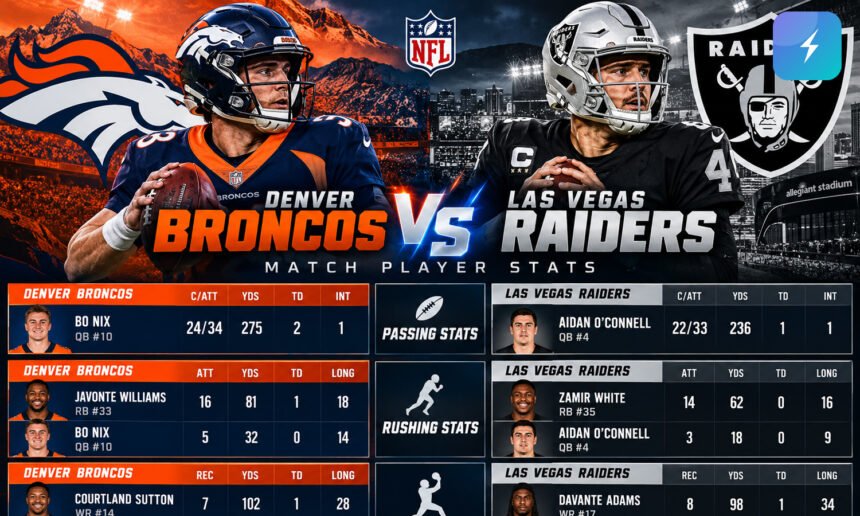
The Denver Broncos vs Las Vegas Raiders match player stats tell the story of one of the NFL’s longest-running AFC West rivalries. These teams meet twice during a normal regular season, so individual performances often matter beyond a single result. Quarterback efficiency, rushing production, defensive pressure, turnovers, third-down execution, and special teams can all decide these divisional games.
As of October 19, 2026, the Broncos and Raiders have not yet played each other in the 2026 regular season. Their first scheduled 2026 meeting is November 22 in Denver, followed by a December 20 matchup in Las Vegas. Therefore, the most recent completed Broncos-Raiders game is the December 7, 2025 contest at Allegiant Stadium. Denver won that game 24-17, completing a season sweep after also beating Las Vegas 10-7 on November 6, 2025.
This article focuses primarily on the latest completed matchup while also examining the first 2025 meeting and recent rivalry trends. That approach gives a more useful picture than treating one box score in isolation.
Denver Broncos vs Las Vegas Raiders Match Overview
The latest completed meeting took place on December 7, 2025, at Allegiant Stadium. Denver entered the contest at 10-2 and left with an 11-2 record after securing a 24-17 victory. Las Vegas fell to 2-11.
Denver built its victory through possession, rushing efficiency, special teams, and long drives rather than explosive passing touchdowns. The Broncos scored in each quarter and led 21-7 after three periods. Las Vegas produced 10 late fourth-quarter points, but the comeback came too late.
| Game Detail | Denver Broncos | Las Vegas Raiders |
|---|---|---|
| Final Score | 24 | 17 |
| Total Net Yards | 356 | 229 |
| Time of Possession | 39:03 | 20:57 |
| Passing Leader | Bo Nix – 212 yards | Geno Smith – 116 yards |
| Rushing Leader | RJ Harvey – 75 yards | Ashton Jeanty – 30 yards |
| Record After Game | 11-2 | 2-11 |
The 127-yard difference in total offense was significant, but the possession numbers were even more revealing. Denver held the football for more than 39 minutes, leaving the Raiders with fewer opportunities to establish offensive rhythm.
Denver Broncos vs Las Vegas Raiders Player Stats
The individual numbers show that this was not a game dominated by one superstar. Instead, Denver received contributions from its quarterback, running game, receivers, defense, kicker, and return unit.
Key Offensive Player Stats
| Player | Team | Key Statistics |
|---|---|---|
| Bo Nix | Broncos | 31/38, 212 passing yards, 0 TD, 0 INT; 15 rushing yards, 1 TD |
| RJ Harvey | Broncos | 17 carries, 75 yards, 1 TD; 6 catches, 25 yards |
| Courtland Sutton | Broncos | 6 catches, 62 yards |
| Geno Smith | Raiders | 13/21, 116 yards, 1 TD, 0 INT |
| Kenny Pickett | Raiders | 8/11, 97 yards, 1 TD, 0 INT |
| Ashton Jeanty | Raiders | 10 carries, 30 yards; 2 catches, 8 yards |
| Jack Bech | Raiders | 6 catches, 50 yards |
| Brock Bowers | Raiders | 4 catches, 46 yards, 1 TD |
These figures show a clear difference in offensive approach. Denver leaned on efficient, controlled football, while Las Vegas struggled to sustain enough offense until late in the game.
Bo Nix Delivered an Efficient Performance
Bo Nix did not throw a touchdown pass, but his performance was important to Denver’s victory.
Nix completed 31 of 38 passes for 212 yards, giving him a completion rate of roughly 81.6%. More importantly, he did not throw an interception. He also carried three times for 15 yards and scored Denver’s opening touchdown on an eight-yard run.
That rushing touchdown capped a long opening drive and immediately demonstrated how Denver wanted to play the game: stay on the field, control possession, and force the Raiders to respond.
Nix’s passing line was not built around deep shots. Denver instead used shorter completions and distributed the ball across numerous targets. This helped the Broncos extend drives while limiting the chances for Las Vegas to create game-changing turnovers.
His 31 completions are especially notable when compared with his first 2025 meeting against the Raiders. In that November game, Nix completed only 16 of 28 passes for 150 yards, with one touchdown and two interceptions. Denver still won 10-7, but the quarterback’s December performance was considerably cleaner.
RJ Harvey Powered Denver’s Ground Game
RJ Harvey was one of the central figures in Denver’s offensive plan.
He carried 17 times for 75 yards, averaging approximately 4.4 yards per attempt, and scored on a three-yard run in the third quarter. Harvey also contributed as a receiver, catching all six of his listed receptions for 25 yards.
His combined rushing and receiving production gave Denver 100 yards from scrimmage.
The importance of Harvey’s performance goes beyond the raw total. His rushing helped Denver stay in manageable down-and-distance situations and maintain long possessions. His third-quarter touchdown finished a 14-play, 91-yard drive that lasted more than nine minutes. That possession pushed Denver’s lead to 21-7 and placed enormous pressure on a Raiders offense that had already spent much of the afternoon on the sideline.
Courtland Sutton Led Denver’s Receivers
Courtland Sutton remained a reliable target for Nix, finishing with six receptions for 62 yards. His longest reception went for 14 yards.
Those numbers may look modest for a No. 1 receiver, but Denver did not need one receiver to dominate the game. Sutton provided dependable production while the Broncos spread targets among Pat Bryant, Lil’Jordan Humphrey, Harvey, Troy Franklin, Adam Trautman and other options.
Pat Bryant recorded four receptions for 32 yards, while Humphrey added three catches for 27 yards. Harvey’s six catches from the backfield gave Nix another dependable short-area option.
The distribution helped explain why Nix was able to complete 31 passes without producing a 100-yard receiver.
Geno Smith’s Performance for the Raiders
Geno Smith started at quarterback for Las Vegas and completed 13 of 21 attempts for 116 yards and one touchdown without throwing an interception.
His touchdown came on a 15-yard pass to Brock Bowers at the end of the first quarter, tying the game 7-7. It was Las Vegas’ only touchdown until late in the fourth quarter.
Smith was sacked three times and later left the contest with a shoulder injury, according to the Raiders’ postgame recap. Kenny Pickett took over and provided some late production.
Smith’s numbers demonstrate one of the Raiders’ biggest problems in the matchup. Las Vegas simply did not generate enough sustained offense while Denver controlled possession.
Kenny Pickett Provided a Late Spark
Kenny Pickett completed 8 of 11 passes for 97 yards and a touchdown after replacing Smith.
His biggest scoring play was a 25-yard touchdown pass to Shedrick Jackson with 2:17 remaining. The score reduced Denver’s advantage to 24-14.
Pickett’s late performance made the final score closer, but Denver had already built enough of a cushion. Daniel Carlson added a 46-yard field goal as time expired, producing the final 24-17 score.
Pickett’s efficiency was nevertheless one of the positive individual takeaways for Las Vegas.
Ashton Jeanty Was Contained on the Ground
One of Denver’s biggest defensive achievements was limiting Ashton Jeanty.
Jeanty carried 10 times for only 30 yards, an average of 3.0 yards per carry. He added two receptions for eight yards.
His limited production was particularly important because Jeanty had been more effective in the first meeting. On November 6, he recorded 19 carries for 60 yards and a touchdown. That four-yard touchdown run gave Las Vegas an early 7-0 lead in Denver.
In the December rematch, Denver prevented him from becoming the foundation of a productive rushing attack. The Raiders finished with only 40 rushing yards as a team, while Denver accumulated 152. The 112-yard rushing advantage helped shape both possession and field position.
Brock Bowers Made an Impact
Brock Bowers remained one of the Raiders’ important receiving weapons.
He caught four passes for 46 yards and one touchdown, including the 15-yard first-quarter score from Smith. That play answered Denver’s opening touchdown and briefly brought the game level at 7-7.
Bowers’ production was much better than in the teams’ November meeting, when he was held to one catch for 31 yards. However, the Raiders still could not create enough sustained drives around him.
Jack Bech actually led Las Vegas in receptions and receiving yards in the December game, recording six catches for 50 yards.
Marvin Mims Jr. Changed the Game on Special Teams
One of the biggest plays did not come from either offense.
With the game tied 7-7 in the second quarter, Marvin Mims Jr. returned a punt 48 yards for a touchdown, giving Denver a 14-7 lead.
That score was particularly valuable because Denver did not need its offense to drive the length of the field. In a divisional matchup where possessions matter, a special-teams touchdown can completely alter the game.
Las Vegas then went scoreless throughout the second and third quarters while Denver extended its advantage.
Wil Lutz Added Important Points
Wil Lutz was perfect on the scoring opportunities reflected in the game summary.
He converted Denver’s three extra points and kicked a 23-yard fourth-quarter field goal, pushing the Broncos’ lead from 21-7 to 24-7.
That field goal mattered because Las Vegas later scored 10 points. Without it, the Raiders’ late push could have created a much more dangerous one-score situation earlier.
Special teams therefore contributed 10 of Denver’s 24 points when combining Mims’ punt-return touchdown, Lutz’s field goal, and his extra points.
Team Stats Explain Denver’s Victory
Individual player statistics matter, but the broader numbers reveal why Denver controlled the contest.
The Broncos finished with 356 total net yards compared with 229 for Las Vegas. Denver also held the football for 39:03, while the Raiders possessed it for only 20:57.
Denver converted 7 of 12 third downs, another important reason its offense remained on the field. The Raiders’ official recap specifically highlighted the third-down difference, the nearly 20-minute possession gap, and Denver’s large advantage on the ground.
Those statistics connect directly. A successful running game creates manageable third downs. Converting those third downs extends possessions. Extended possessions reduce opportunities for the opposing offense.
Denver executed that cycle effectively.
How the Scoring Developed
Denver opened the game with an impressive 14-play, 81-yard possession lasting 8:54. Nix completed the drive with an eight-yard touchdown run.
Las Vegas answered before the end of the first quarter. Smith connected with Bowers for a 15-yard touchdown, making it 7-7.
The turning point arrived in the second quarter when Mims returned a punt 48 yards for a touchdown. Denver entered halftime leading 14-7.
The Broncos then produced another long possession in the third quarter. A 14-play, 91-yard drive consumed 9:13 and ended with Harvey’s three-yard touchdown run.
Lutz made it 24-7 with a 23-yard field goal in the fourth quarter. Pickett’s 25-yard touchdown pass to Jackson and Carlson’s field goal produced the final 24-17 margin.
First 2025 Broncos vs Raiders Meeting: Player Stats
The November 6 matchup looked very different.
Denver won only 10-7 at Empower Field at Mile High. The Broncos produced 220 total net yards, while Las Vegas had 188. Both teams recorded just 10 first downs.
Nix finished 16-of-28 for 150 yards, one touchdown and two interceptions. Geno Smith went 16-of-26 for 143 yards with no touchdowns and one interception.
J.K. Dobbins was Denver’s leading rusher with 77 yards on 18 attempts. Jeanty led Las Vegas with 60 yards and one touchdown on 19 carries.
Troy Franklin caught five passes for 40 yards and scored Denver’s only touchdown. Tyler Lockett led Las Vegas with five receptions for 44 yards.
The game was tied 7-7 at halftime. Wil Lutz eventually kicked a 32-yard field goal in the third quarter, and neither team scored again.
Comparing the Two 2025 Meetings
Denver swept Las Vegas in 2025, but the victories were achieved differently.
In November, the Broncos survived a defensive struggle despite Nix throwing two interceptions. In December, they played a cleaner offensive game, dominated possession, ran the ball effectively, and received a special-teams touchdown.
Across the two games, Las Vegas scored only 24 total points, while Denver scored 34. More importantly, Denver found different ways to win.
The Broncos’ ability to adjust between meetings is visible in Nix’s numbers. He moved from 16 completions, 150 yards and two interceptions in the first game to 31 completions, 212 yards and no interceptions in the second.
Recent Broncos-Raiders Rivalry Results
The rivalry shifted noticeably in Denver’s favor during 2024 and 2025.
Denver won 34-18 on October 6, 2024, then 29-19 on November 24, 2024. The Broncos followed those victories with the 10-7 and 24-17 wins in 2025.
That means Denver won four consecutive meetings across the 2024 and 2025 seasons.
However, the broader rivalry has a much longer history. The Football Database lists the series at 73 Raiders wins, 58 Broncos wins and two ties through the end of the 2025 meetings, including postseason games.
So recent momentum and all-time history tell different stories: Denver controlled the latest stretch, while the Raiders still held the historical series advantage at that point.
What the Player Stats Reveal About Denver
The December numbers show a Denver team capable of winning without depending on huge passing plays.
Nix protected the football and completed a high percentage of his passes. Harvey supplied steady rushing production. Sutton offered reliability in the passing game. Mims delivered a game-changing special-teams play, and the defense prevented Las Vegas from building a consistent ground attack.
Perhaps the most impressive figure was Denver’s 39:03 possession time.
Keeping the ball for nearly two-thirds of a game reduces pressure on the defense and limits the number of possessions available to the opponent. Denver’s long drives repeatedly forced Las Vegas to watch from the sideline.
What the Stats Reveal About Las Vegas
The Raiders’ biggest problem was not one disastrous statistic. It was their inability to create enough sustained offense.
Smith was relatively efficient before leaving the game, and Pickett produced a touchdown after entering. Bowers and Bech both contributed as receivers. Yet Las Vegas generated only 229 total net yards and 40 rushing yards.
Jeanty’s limited rushing output made it difficult for the Raiders to establish offensive balance. Denver could pressure the passing game without having to respect a consistently productive rushing attack.
The late scoring run showed that Las Vegas still had some offensive life, but by then the Broncos had controlled too much of the game.
Upcoming Denver Broncos vs Las Vegas Raiders Games in 2026
Because the current date is October 19, 2026, there are no verified 2026 Broncos-Raiders match player stats yet. The teams have not played each other this season.
The first 2026 meeting is scheduled for November 22 at Empower Field at Mile High, with the Raiders visiting Denver. The second is scheduled for December 20 at Allegiant Stadium in Las Vegas.
Any article claiming to provide player statistics from those 2026 games before they occur would be presenting unverified or fabricated information.
Once those games are completed, the most useful comparison will be whether Las Vegas can improve its rushing efficiency and possession time, and whether Denver can continue the recent success it enjoyed across the 2024 and 2025 series.
Why Player Stats Matter in This Rivalry
Box scores do more than identify the leading passer, rusher, or receiver.
In the Broncos-Raiders rivalry, statistics help explain how each team actually controlled the game. Passing yards alone, for example, would not fully explain Denver’s December 2025 victory. Nix had only 212 passing yards and no passing touchdowns.
The bigger story was the combination of an efficient completion rate, 152 team rushing yards, third-down success, nearly 40 minutes of possession, a punt-return touchdown, and a defense that limited the Raiders’ running game.
That is why complete match analysis should examine player stats alongside team statistics and scoring context.
Conclusion
The latest completed Denver Broncos vs Las Vegas Raiders match player stats show a convincing all-around Denver performance in the 24-17 victory on December 7, 2025. Bo Nix completed 31 of 38 passes for 212 yards and added a rushing touchdown, while RJ Harvey produced 75 rushing yards, 25 receiving yards and a touchdown. Courtland Sutton led Denver with 62 receiving yards, and Marvin Mims Jr.’s 48-yard punt-return touchdown became one of the game’s defining moments.
Las Vegas received a touchdown pass from Geno Smith to Brock Bowers and another from Kenny Pickett to Shedrick Jackson, but the Raiders struggled to run the football and could not keep their offense on the field long enough. Denver’s 356-229 advantage in total net yards and 39:03-20:57 edge in possession illustrate how thoroughly the Broncos controlled the pace.
Combined with Denver’s 10-7 win in November, the result completed a 2025 season sweep and extended the Broncos’ recent winning run against their AFC West rival. The next chapter is scheduled for November 22, 2026, when Las Vegas visits Denver.
Frequently Asked Questions
Who won the latest Denver Broncos vs Las Vegas Raiders game?
The Denver Broncos won the latest completed matchup 24-17 on December 7, 2025, at Allegiant Stadium. Denver improved to 11-2 with the victory.
What were Bo Nix’s stats against the Raiders?
In the December 7, 2025 game, Bo Nix completed 31 of 38 passes for 212 yards, with no passing touchdowns and no interceptions. He also rushed three times for 15 yards and scored an eight-yard rushing touchdown.
Who was the leading rusher in Broncos vs Raiders?
RJ Harvey led the December 2025 matchup with 75 rushing yards on 17 carries and scored one touchdown. Ashton Jeanty led Las Vegas with 30 yards on 10 carries.
How did the Broncos perform against the Raiders in 2025?
Denver swept the two-game regular-season series. The Broncos won 10-7 on November 6, 2025, and 24-17 on December 7, 2025.
When do the Broncos and Raiders play in 2026?
Their first 2026 meeting is scheduled for November 22 in Denver, and the second is scheduled for December 20 in Las Vegas. Because both games are still upcoming as of October 19, 2026, verified 2026 match player stats are not yet available.
Detroit Lions vs Baltimore Ravens Match Player Stats: Complete Breakdown, Highlights & Analysis
Carolina Panthers vs 49ers Match Player Stats: Full Box Score, Highlights and Game Analysis