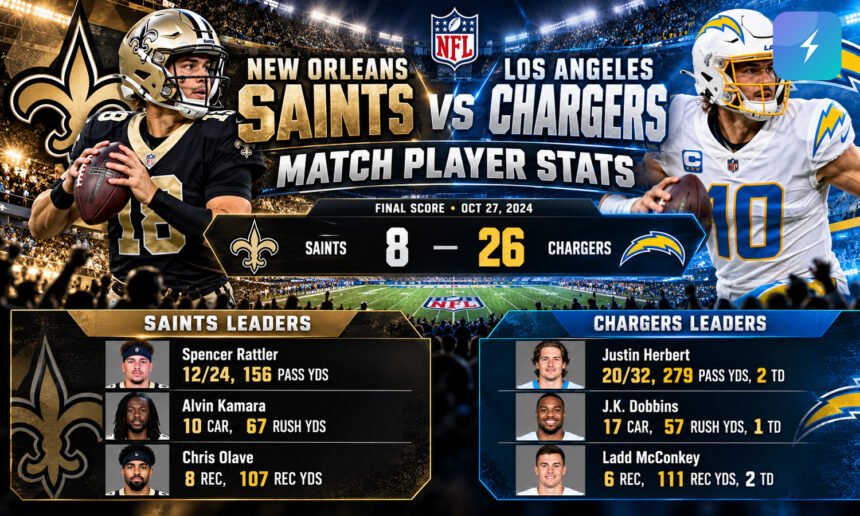
The New Orleans Saints vs Los Angeles Chargers match player stats from their October 27, 2024 meeting tell the story of a game that was closer in total yardage than the final score suggests. Playing at SoFi Stadium in Inglewood, California, the Chargers defeated the Saints 26–8, improving to 4–3 while New Orleans fell to 2–6. Los Angeles finished with 378 total yards compared with 366 for New Orleans, but the Chargers were much better at turning productive plays into points. Justin Herbert delivered an efficient performance with 279 passing yards and two touchdowns, while rookie receiver Ladd McConkey produced the game’s biggest receiving performance. New Orleans found some offensive yardage through Chris Olave and Alvin Kamara, yet the Saints never scored an offensive touchdown.
New Orleans Saints vs Los Angeles Chargers Match Overview
This Week 8 matchup took place on October 27, 2024, with the Chargers hosting the Saints at SoFi Stadium. Los Angeles entered the game trying to rebound from a narrow 17–15 loss to Arizona, while New Orleans was attempting to stop a losing streak after opening the season 2–0.
The game started in unusual fashion. New Orleans scored first with a safety in the opening quarter, giving the Saints a 2–0 advantage. The Chargers responded in the second quarter with a Cameron Dicker field goal and a one-yard J.K. Dobbins touchdown run. Blake Grupe’s field goal just before halftime cut the Chargers’ advantage to 9–5.
The second half belonged to Los Angeles. Herbert connected with McConkey for a 60-yard touchdown in the third quarter. Grupe answered with another field goal, but New Orleans never scored again. Dicker added a fourth-quarter field goal before Herbert found McConkey for another touchdown, this time from nine yards, to complete the 26–8 victory.
| Game Detail | Result |
|---|---|
| Date | October 27, 2024 |
| Venue | SoFi Stadium, Inglewood, California |
| Final Score | Chargers 26, Saints 8 |
| Halftime Score | Chargers 9, Saints 5 |
| Chargers Record After Game | 4–3 |
| Saints Record After Game | 2–6 |
| Chargers Total Yards | 378 |
| Saints Total Yards | 366 |
New Orleans Saints vs Los Angeles Chargers Match Player Stats at a Glance
The most important individual numbers came from Herbert, McConkey, Olave and Kamara. Herbert controlled the Chargers’ passing game, completing 20 of 32 attempts for 279 yards, two touchdowns and no interceptions. He also created problems with his legs, rushing four times for 49 yards.
McConkey was Herbert’s biggest difference-maker. He caught all six of his targets for 111 yards and two touchdowns, including the 60-yard score that changed the feel of the game in the third quarter.
For New Orleans, Olave remained the leading downfield receiving threat. He caught eight passes for 107 yards on 14 targets. Kamara contributed both as a runner and receiver, recording 67 rushing yards and 55 receiving yards.
| Player | Team | Key Statistics |
|---|---|---|
| Justin Herbert | Chargers | 20/32, 279 pass yards, 2 TD, 0 INT; 49 rush yards |
| Ladd McConkey | Chargers | 6 receptions, 111 yards, 2 TD |
| J.K. Dobbins | Chargers | 17 carries, 57 yards, 1 TD |
| Joshua Palmer | Chargers | 2 receptions, 72 yards |
| Spencer Rattler | Saints | 12/24, 156 yards, 0 TD, 0 INT |
| Jake Haener | Saints | 9/17, 122 yards, 0 TD, 0 INT |
| Chris Olave | Saints | 8 receptions, 107 yards |
| Alvin Kamara | Saints | 10 carries, 67 yards; 6 catches, 55 yards |
Justin Herbert’s Performance Led the Chargers Offense
Justin Herbert was the most influential quarterback in the game. His raw passing line was strong, but his performance becomes even more impressive when his rushing production is included.
Herbert completed 20 of 32 passes for 279 yards and two touchdowns, finishing with a 111.3 passer rating. Most importantly, he did not throw an interception. That allowed Los Angeles to play a controlled game rather than giving New Orleans easy opportunities through turnovers.
Herbert also ran four times for 49 yards, including a 38-yard rush. Those yards mattered because they gave the Chargers another way to escape pressure and extend offensive possessions.
His two touchdown passes both went to McConkey. The 60-yard third-quarter connection was especially important. Los Angeles had led only 9–5 at halftime, so the game remained within one possession. Herbert’s deep completion to McConkey suddenly made it 16–5 and forced New Orleans to chase the game.
Later, Herbert and McConkey connected for a nine-yard touchdown that effectively finished the contest.
Ladd McConkey Was the Offensive Star of the Game
Among all the New Orleans Saints vs Los Angeles Chargers match player stats, McConkey’s receiving line stands out immediately.
The rookie wide receiver finished with:
6 targets, 6 receptions, 111 receiving yards and 2 touchdowns.
That means every pass thrown his way was completed. His 60-yard touchdown provided the biggest offensive play of the afternoon, while his nine-yard touchdown in the fourth quarter gave the Chargers their final points.
McConkey’s performance was not simply about volume. He produced 111 yards on only six receptions, averaging 18.5 yards per catch. His combination of efficiency and explosive production gave Herbert the weapon needed to break open what had been a low-scoring contest.
Chargers Receiving Stats Beyond McConkey
McConkey led the receiving group, but he was not the only Charger to create meaningful yardage.
Joshua Palmer caught two of four targets for 72 yards, including a 45-yard reception. His limited number of catches therefore had a significant effect on field position.
Tight end Will Dissly provided the more consistent underneath option. He was targeted seven times and finished with five receptions for 41 yards. Jalen Reagor added two catches for 35 yards, while Scott Matlock recorded a nine-yard reception.
J.K. Dobbins was also involved as a receiver, catching four passes for 11 yards.
The distribution shows that Los Angeles did not depend entirely on one player. McConkey supplied the touchdowns and the biggest play, but Herbert successfully moved the ball to several receivers.
J.K. Dobbins and the Chargers Running Game
J.K. Dobbins was the Chargers’ primary running back and finished with 17 carries for 57 yards and one touchdown.
His rushing average was not spectacular, but his one-yard touchdown in the second quarter gave Los Angeles a 9–2 lead. In a game where New Orleans struggled to score touchdowns, that short rushing score became increasingly valuable.
Kimani Vidal added 16 yards on six carries. Herbert, however, was actually one of the most productive Chargers runners because of his 49 yards on only four attempts.
Los Angeles ultimately recorded 122 rushing yards as a team. New Orleans had 117. The difference was small, but the Chargers combined their rushing attack with a more dangerous passing game and better scoring efficiency.
Spencer Rattler’s Difficult Start for New Orleans
The Saints entered the matchup without starting quarterback Derek Carr, leaving rookie Spencer Rattler to start.
Rattler completed 12 of 24 passes for 156 yards, with no touchdowns and no interceptions. He was sacked three times for 16 yards and finished with a passer rating of 70.8.
The lack of turnovers was a positive, but New Orleans needed more offensive production. Rattler was eventually replaced by Jake Haener.
The quarterback change reflected the larger problem facing the Saints. They were gaining some yardage but could not consistently finish possessions with touchdowns.
Jake Haener’s Second-Half Production
Jake Haener completed 9 of 17 passes for 122 yards after entering the game. Like Rattler, he did not throw a touchdown or interception.
Haener also rushed twice for 10 yards and was sacked twice.
When the Saints’ quarterback statistics are combined with Taysom Hill’s single completion, New Orleans completed 22 passes for 281 gross passing yards. The team therefore generated more offensive movement than the eight-point final score might suggest.
The problem was finishing drives. Passing yards alone do not win games, and the Saints could not translate their production into touchdowns.
Chris Olave Led the Saints Receiving Attack
Chris Olave was clearly the Saints’ leading receiver.
He was targeted 14 times, catching eight passes for 107 yards. His longest reception went for 28 yards. No other New Orleans player reached 50 receiving yards except Kamara, who finished with 55.
Olave’s 107-yard performance demonstrated that the Saints could move the football through the air. At the same time, the fact that he was targeted 14 times without scoring shows the difference between gaining yards and producing points.
New Orleans needed Olave’s ability to stretch the field, but the Chargers prevented his production from becoming touchdowns.
Alvin Kamara Produced 122 Yards From Scrimmage
Alvin Kamara remained central to almost everything New Orleans attempted offensively.
He carried the ball 10 times for 67 rushing yards, averaging 6.7 yards per attempt. He also received 11 targets, catching six passes for 55 yards.
That gave Kamara 122 yards from scrimmage.
His longest run covered 24 yards, while his longest reception went for 37. Those numbers demonstrate that Kamara was capable of producing explosive plays in both phases.
Yet he did not score a touchdown. That was the theme of the Saints’ offense: several players posted respectable individual numbers, but the team could not convert them into enough points.
Other Important Saints Offensive Contributors
Taysom Hill continued to fill multiple roles. He carried four times for 20 yards, caught two passes for 21 yards and completed his only pass attempt for three yards.
Juwan Johnson caught three of four targets for 48 yards, while Bub Means made one reception for 36 yards. Mason Tipton caught both of his targets for 14 yards.
Kendre Miller added 16 rushing yards on three attempts, and Jamaal Williams rushed twice for four yards.
These contributions helped New Orleans reach 366 total yards. Statistically, that was only 12 fewer than the Chargers. The final 18-point scoring difference therefore came less from a huge yardage gap and more from how each offense used its opportunities.
Saints vs Chargers Scoring Summary
The scoring sequence helps explain how Los Angeles gradually took control.
| Quarter | Scoring Play | Score After Play |
|---|---|---|
| 1st | Saints safety | Saints 2–0 |
| 2nd | Cameron Dicker 46-yard field goal | Chargers 3–2 |
| 2nd | J.K. Dobbins 1-yard TD run | Chargers 9–2 |
| 2nd | Blake Grupe 40-yard field goal | Chargers 9–5 |
| 3rd | Ladd McConkey 60-yard TD reception | Chargers 16–5 |
| 3rd | Blake Grupe 43-yard field goal | Chargers 16–8 |
| 4th | Cameron Dicker 29-yard field goal | Chargers 19–8 |
| 4th | Ladd McConkey 9-yard TD reception | Chargers 26–8 |
New Orleans never trailed by an overwhelming margin during the first half. The Saints were down only four points at halftime. The decisive stretch came after the break, when Los Angeles scored 17 points compared with three for New Orleans.
Why the Saints Had 366 Yards but Only Eight Points
One of the most interesting statistics from the game is the total-yard comparison.
Los Angeles gained 378 yards. New Orleans gained 366.
Looking only at those figures, an 18-point victory seems surprising. But total yardage does not show where drives end, how often an offense reaches scoring position, or whether explosive plays result in touchdowns.
The Chargers scored three touchdowns: Dobbins’ rushing score and McConkey’s two receiving touchdowns. New Orleans scored none.
The Saints’ eight points came from a safety and two Blake Grupe field goals. Their offense therefore accounted for only six points.
That gap in touchdown production explains far more about the final score than the 12-yard difference between the teams.
The 60-Yard Herbert-to-McConkey Touchdown Changed the Game
At halftime, the Chargers led just 9–5. New Orleans was still one touchdown away from potentially taking the lead.
That changed in the third quarter.
Herbert hit McConkey for a 60-yard touchdown, pushing the lead to 16–5. The Saints later responded with a field goal, but field goals were not enough once Los Angeles began producing touchdowns.
The play also demonstrated the value of explosive offense. A team can build long drives with short gains, but one successful deep connection can immediately change the scoreboard and game situation.
McConkey’s speed and Herbert’s arm gave the Chargers that dimension.
Defensive Pressure Also Mattered
Neither quarterback group had a completely clean afternoon.
Herbert was sacked three times for 23 yards, while the Chargers brought down New Orleans quarterbacks five times overall: Rattler three times and Haener twice.
The Saints did create pressure. Official team photography from the matchup documents Carl Granderson getting to Herbert, a group sack involving Alontae Taylor, Chase Young and Bryan Bresee, and another sack involving Ugo Amadi and Young.
The Chargers’ defense, however, benefited from New Orleans’ inability to finish drives. Even when the Saints accumulated yardage, Los Angeles repeatedly prevented them from reaching the end zone.
Special Teams Had an Unusual Impact
Special teams and non-offensive scoring played a noticeable role.
The Saints’ first two points came from a safety rather than an offensive drive. Blake Grupe then made field goals from 40 and 43 yards, accounting for the remaining six New Orleans points.
Cameron Dicker made field goals from 46 and 29 yards for Los Angeles. He missed the extra point following Dobbins’ touchdown but converted the extra points after McConkey’s two touchdowns.
For New Orleans, reliable kicking kept the game reasonably close for a while, but field goals could not compensate for an offense that never reached the end zone.
Key Statistical Differences Between the Saints and Chargers
The overall statistics reveal an unusual game because the teams were not separated by hundreds of yards.
The Chargers recorded 378 total yards and 19 first downs, while the Saints had 366 yards and 15 first downs. Los Angeles produced 256 net passing yards and 122 rushing yards. New Orleans finished with 249 net passing yards and 117 rushing yards.
Those numbers were remarkably close.
The major difference was scoring efficiency. Los Angeles produced three touchdowns and two field goals. New Orleans produced no offensive touchdowns.
The Chargers also had the game’s most decisive explosive play through McConkey’s 60-yard touchdown and received 49 rushing yards from Herbert, giving the Saints another element to defend.
What the Player Stats Reveal About the Chargers’ Victory
The numbers point to three main reasons Los Angeles won.
First, Herbert was the game’s most effective quarterback. His 279 passing yards, two touchdowns, zero interceptions and 49 rushing yards gave Los Angeles both efficiency and explosiveness.
Second, McConkey turned limited opportunities into maximum impact. Six targets became six catches, 111 yards and two touchdowns.
Third, the Chargers converted offensive production into touchdowns. New Orleans had 366 total yards, Olave surpassed 100 receiving yards, and Kamara surpassed 100 scrimmage yards. Those are respectable individual numbers. But none resulted in a Saints touchdown.
That distinction explains why the box score can look relatively competitive while the scoreboard reads 26–8.
What the Match Meant for Both Teams
The victory moved Los Angeles to 4–3 and became the beginning of a productive stretch. The Chargers followed it by defeating Cleveland, Tennessee and Cincinnati, creating a four-game winning streak that moved them firmly into playoff contention.
For New Orleans, the defeat dropped the team to 2–6. The Saints then lost 23–22 to Carolina the following week before eventually ending their losing streak against Atlanta.
Viewed in the larger context of the 2024 season, this game highlighted two teams moving in different directions at that stage of the schedule.
Most Important New Orleans Saints vs Los Angeles Chargers Match Player Stats
For readers looking for the essential numbers, Herbert led all passers with 279 yards and two touchdowns. Kamara led all players in rushing yards with 67, narrowly ahead of Dobbins’ 57. McConkey led all receivers with 111 yards, while Olave followed closely with 107.
McConkey was the only player with multiple touchdowns. Dobbins scored the other offensive touchdown for Los Angeles.
The Saints did not commit an interception, and their quarterbacks combined for significant passing yardage, but the absence of a touchdown was ultimately more important than their respectable yardage totals.
Conclusion
The New Orleans Saints vs Los Angeles Chargers match player stats show why simply comparing total yards can give an incomplete picture of an NFL game. New Orleans accumulated 366 yards, only 12 fewer than Los Angeles, and received strong individual production from Chris Olave and Alvin Kamara. Yet the Saints scored only eight points and never reached the end zone offensively.
Los Angeles made its opportunities count. Justin Herbert completed 20 of 32 passes for 279 yards and two touchdowns while adding 49 rushing yards. Ladd McConkey delivered the standout performance with six catches for 111 yards and two scores, including a game-changing 60-yard touchdown. J.K. Dobbins added another touchdown on the ground.
The final 26–8 Chargers victory was therefore defined by efficiency rather than overwhelming yardage dominance. Los Angeles created touchdowns, produced explosive plays and protected the football. New Orleans moved the ball at times but could not finish drives. That difference turned a statistically competitive matchup into a comfortable Chargers win.
Frequently Asked Questions
Who won the New Orleans Saints vs Los Angeles Chargers game?
The Los Angeles Chargers defeated the New Orleans Saints 26–8 on October 27, 2024, at SoFi Stadium. The victory improved Los Angeles to 4–3 and dropped New Orleans to 2–6.
What were Justin Herbert’s stats against the Saints?
Justin Herbert completed 20 of 32 passes for 279 yards, two touchdowns and no interceptions. He also rushed four times for 49 yards and finished with a 111.3 passer rating.
What were Ladd McConkey’s stats against New Orleans?
Ladd McConkey caught all six of his targets for 111 yards and two touchdowns. His biggest play was a 60-yard touchdown reception from Justin Herbert in the third quarter.
Who had the most receiving yards in Saints vs Chargers?
Ladd McConkey led the game with 111 receiving yards. Saints receiver Chris Olave was close behind with eight receptions for 107 yards.
How many total yards did the Saints and Chargers have?
The Chargers finished with 378 total yards, while the Saints recorded 366. Despite the small 12-yard difference, Los Angeles won by 18 points because it converted its offensive opportunities into three touchdowns while New Orleans failed to score an offensive touchdown.
Denver Broncos vs Las Vegas Raiders Match Player Stats: Complete Breakdown and Analysis
Detroit Lions vs Dallas Cowboys Match Player Stats: Full 2024 Game Breakdown