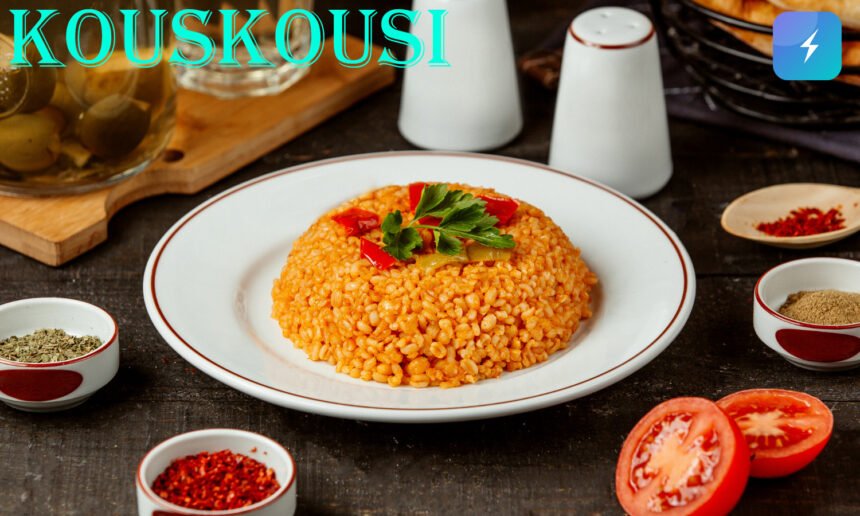
Kouskousi is a traditional Greek food term that can easily cause confusion, especially for English-speaking readers. Its name looks and sounds remarkably similar to couscous, the famous North African semolina staple, and many online articles treat the two as though they are simply different spellings of the same dish. Reliable Greek-language sources, however, provide a more precise explanation. The Dictionary of Standard Modern Greek defines κουσκούσι (kouskousi) as a type of pasta made in small granules and traces the word through Turkish kuskus, ultimately connected with Arabic.
That distinction matters because Greek kouskousi has its own culinary identity. Traditional examples are found particularly in northern Greek food culture, including Thrace and Eastern Macedonia. Depending on the producer and local recipe, it may contain semolina, flour, eggs, milk, and salt, while some commercially produced varieties are made entirely from durum-wheat semolina. It is cooked as pasta and can appear in soups, meat dishes, oven meals, and other recipes where its tiny pieces readily absorb broth and sauce.
What Is Kouskousi?
Kouskousi is the Latin transliteration of the Greek word κουσκούσι. The Greek Language Centre’s Dictionary of Standard Modern Greek describes it straightforwardly as a type of pasta in granules. This is one of the clearest documented definitions and helps separate verified information from the inconsistent descriptions circulating online. The dictionary also gives κουσκούς (kouskous) as a related form.
Physically, kouskousi generally consists of very small pieces or granules rather than the long strands or larger shapes associated with familiar pasta such as spaghetti, penne, or rigatoni. A producer in Thrace describes its version as small, irregular balls. Another Greek retailer lists a commercial version made from 100% durum-wheat semolina. These examples demonstrate an important point: there is not necessarily one universal ingredient formula for every product sold under the name.
The Meaning and Etymology of Kouskousi
The history of the word reflects the movement of food traditions across the Mediterranean and surrounding regions. According to the Dictionary of Standard Modern Greek, kouskousi derives from Turkish kuskus, itself connected to Arabic, with the Greek ending added to the borrowed term. The dictionary describes the underlying meaning as a fine or small pasta.
This linguistic connection explains why kouskousi, Turkish kuskus, and North African couscous have names that look so closely related. It does not mean that every food carrying one of these names is prepared identically. Foods can move between cultures while ingredients, production techniques, cooking methods, and serving traditions change. Kouskousi is a useful example of how a shared family of food terms can develop distinct regional meanings.
Kouskousi in Greek Culinary Tradition
Kouskousi is particularly associated with traditional cooking in parts of northern Greece. Discover Greece, the official tourism platform of Marketing Greece, specifically includes kouskousi when describing the cuisine of Thrace, calling it a pasta resembling Moroccan couscous and noting its presence among regional products. A Greek culinary reference likewise identifies kouskousi as a traditional pasta associated with Eastern Macedonia and Thrace.
Commercial evidence also shows that the food remains part of contemporary regional production rather than existing only as a historical recipe. Thrakiotiki Zimi markets both machine-produced and handmade versions and identifies its product as Thracian kouskous or kouskousi. Products described as kouskousi are also sold elsewhere in Greece, including versions from Macedonia and Lemnos. These regional examples indicate that the term is not limited to a single village or one strictly standardized recipe.
How Traditional Kouskousi Is Made
Traditional preparation can involve flour or semolina combined with ingredients such as eggs and milk. A Greek culinary source describes an Eastern Macedonian and Thracian version made with egg, milk, salt, flour, and usually semolina or bulgur. The mixture is worked and broken into many tiny pieces, traditionally using the hands or a sieve, before being dried.
Modern recipes and commercial products vary considerably. One packaged Greek kouskousi lists semolina, flour, eggs, cow’s milk, and salt, while a Lemnos version lists local hard-wheat flour, sheep’s milk, and eggs. By contrast, another commercial product identified as kouskousi is made from 100% durum-wheat semolina. Therefore, claims that all kouskousi contains eggs or milk—or that all of it consists solely of semolina—would be inaccurate.
Handmade and Commercial Versions
Handmade kouskousi emphasizes the older process of forming and drying the tiny pasta pieces. Thrakiotiki Zimi describes its handmade product as traditionally kneaded and shaped by hand, combining wheat with milk and eggs. Such production helps preserve the irregular appearance associated with handmade pasta.
Commercial production can make the pieces more consistent and reduce the labor required. That does not automatically determine quality or authenticity; it simply represents a different production method. Consumers interested in a particular style should check the actual ingredient list and cooking instructions rather than assuming every package labeled kouskousi follows the same traditional formula.
Kouskousi vs. North African Couscous
This is the most important distinction for anyone researching the keyword. Greek kouskousi and North African couscous are historically and linguistically related food concepts, but reputable sources do not support treating every Greek kouskousi as identical to traditional Maghrebi couscous.
Traditional North African couscous involves semolina that is rolled into granules and steamed. UNESCO describes its preparation as a process beginning with cereal cultivation and grinding, followed by rolling semolina by hand, steaming, and cooking. The traditions surrounding couscous in Algeria, Mauritania, Morocco, and Tunisia were added to UNESCO’s Representative List of the Intangible Cultural Heritage of Humanity in 2020.
Greek kouskousi, meanwhile, is explicitly classified by the Greek dictionary as pasta in granules. Traditional Greek varieties can contain eggs and milk and are commonly cooked in liquid like other small pasta. Discover Greece even describes Thracian kouskousi as a pasta that resembles Moroccan couscous, wording that appropriately recognizes the similarity without presenting them as identical foods.
| Feature | Greek Kouskousi | Traditional North African Couscous |
|---|---|---|
| Basic category | Small granular pasta | Rolled semolina preparation |
| Common base | Flour and/or semolina | Semolina |
| Eggs or milk | Present in some traditional varieties | Not defining ingredients |
| Traditional cooking | Often cooked like small pasta | Traditionally steamed |
| Cultural association | Greece, especially regional northern traditions | Maghreb/North Africa |
| Appearance | Tiny granules or irregular balls | Tiny semolina granules |
The resemblance is real, as are the linguistic connections, but the terms should not be collapsed into a single universal recipe.
How Kouskousi Is Cooked
Because kouskousi recipes vary, there is no reliable universal cooking time or water ratio that applies to every product. Packaged varieties should be prepared according to their manufacturer’s directions. For example, one Lemnos product gives a cooking time of approximately five to six minutes, but that figure should not be generalized to all kouskousi.
In Greek cooking, the pasta can be incorporated into dishes where it absorbs liquid and flavor. Culinary sources mention pairing it with meat, poultry, red sauces, seafood, soups, and cooked dishes. Its small size gives it considerable surface contact with broth or sauce, making it particularly practical in recipes where the pasta is expected to become integrated with the other ingredients rather than remain a separate component.
Cooking Kouskousi Without Making It Mushy
The safest approach is to follow the instructions for the exact variety being used. Small pasta can move from firm to very soft relatively quickly, particularly when left in hot broth after active cooking has stopped.
When using kouskousi in soup, it is also worth remembering that pasta can continue absorbing liquid as the dish rests. If leftovers are expected, keeping additional broth available can help restore the desired consistency during reheating.
Ingredients and Nutrition
There is no single nutritional profile that accurately represents every form of kouskousi. Nutrition depends heavily on ingredients. A product made solely from durum-wheat semolina will differ from a traditional recipe containing flour, milk, and eggs.
For example, one Greek commercial product lists semolina, flour, eggs, cow’s milk, and salt and reports 386 kcal per 100 grams. That figure describes that specific product, not kouskousi as an entire category. Other versions have different formulas and therefore potentially different nutritional values.
The same caution applies to allergens. Because kouskousi is wheat-based, conventional varieties contain gluten. Products containing eggs or milk introduce additional allergens. Anyone managing food allergies or dietary restrictions should therefore read the package label instead of relying on a generic online description.
Common Ways to Use Kouskousi
Kouskousi’s small shape makes it flexible enough for several styles of cooking. Traditional Greek sources describe it alongside meat and poultry, in red sauces, with seafood such as mussels and shrimp, and as an addition to soups and stews.
Some practical uses include:
- adding it to chicken or meat dishes;
- cooking it directly in a flavorful broth;
- using it as a small-pasta component in soup;
- combining it with tomato-based sauces;
- serving it alongside vegetables;
- incorporating it into seafood dishes;
- preparing it as a warm side dish.
These are applications rather than rigid rules. The exact method should reflect the ingredients and size of the kouskousi being used.
Why Kouskousi Is Often Misidentified Online
The confusion surrounding kouskousi is understandable. Searching the Latin spelling produces contradictory explanations. Some recent English-language pages simply define it as another name for North African couscous, while others describe it as Greek pasta. The authoritative Greek dictionary resolves much of this ambiguity by documenting κουσκούσι specifically as granular pasta.
The second source of confusion is visual similarity. Both Greek kouskousi and couscous can appear as collections of tiny wheat-based particles. Their names are also historically connected. Without information about ingredients and preparation, a photograph alone may not make the distinction obvious.
For accurate identification, the best questions are not simply “What does it look like?” but “Where was the product made?”, “What ingredients does it contain?”, and “How does the producer instruct you to cook it?”
Does Kouskousi Have Anything to Do With Technology or AI?
No reliable evidence found during research identifies Kouskousi as a recognized technology platform, AI service, software product, automation system, or digital application. The well-supported meaning is culinary.
This is important because generic article templates sometimes force sections about artificial intelligence, integrations, security, privacy, accounts, subscriptions, or software features onto unfamiliar keywords. Doing that here would create unsupported information. There are no verified AI capabilities, APIs, integrations, privacy policies, cybersecurity features, software owners, or technology specifications associated with the traditional food term discussed in this article.
The relevant “technology” is food production technology: traditional hand shaping and drying can now coexist with mechanized pasta manufacturing and modern packaging. That is very different from claiming Kouskousi is a digital platform.
Storage and Practical Buying Guidance
Dry kouskousi should generally be handled like the dry pasta product indicated on its packaging. One traditional Macedonian product, for example, explicitly instructs consumers to store it in a cool, dry place. Manufacturer instructions remain the appropriate authority because formulations containing ingredients such as egg and milk can differ between brands.
When buying kouskousi, check the ingredient list carefully. A product made from 100% durum semolina may provide a different result from a traditional version made with flour, eggs, and milk. Neither ingredient list should automatically be treated as the only legitimate definition because documented Greek products demonstrate that multiple formulations exist.
People trying it for the first time should also look at the size of the pieces and the manufacturer’s suggested preparation. Fine varieties can cook rapidly, while handmade or larger pieces may behave differently.
Cultural Importance and Regional Identity
Kouskousi illustrates how seemingly simple foods can preserve regional history. Its presence in Thracian cuisine is documented by Greece’s tourism resources, while contemporary producers continue to sell both handmade and machine-produced forms.
The broader history surrounding couscous-like foods also demonstrates centuries of culinary exchange across North Africa, the Mediterranean, the Middle East, Anatolia, and southeastern Europe. Similar names do not erase local differences. Instead, they show how communities can adopt an ingredient or preparation concept and reshape it around locally available wheat, dairy products, eggs, cooking methods, and family traditions.
That makes kouskousi interesting not because it is a mysterious new “superfood,” but because it represents the much more meaningful story of food moving between cultures while developing distinct regional forms.
What Is Verified and What Remains Uncertain?
Several facts can be established with reasonable confidence. Kouskousi is a documented Greek word. An authoritative Greek dictionary defines it as a type of pasta in granules and traces the term through Turkish kuskus to Arabic. Greek culinary and tourism sources associate kouskousi with regional cooking, including Thrace and Eastern Macedonia. Existing products confirm that both handmade and commercially manufactured forms are available.
What cannot responsibly be stated is that every food called kouskousi follows one recipe, has one exact place or date of invention, or is simply identical to Moroccan or other North African couscous. Likewise, there is no basis for assigning a universal calorie count, cooking time, or ingredient list to all kouskousi.
Claims about an exact inventor, precise invention date, universally standardized traditional recipe, or unique health effects should therefore be treated cautiously unless supported by stronger historical or scientific evidence.
The Future of Kouskousi
Kouskousi does not need technological reinvention to remain relevant. Its future is more likely to come through the continued production and rediscovery of regional Greek foods. Traditional pasta makers can preserve handmade techniques, while larger producers make granular pasta available to consumers who may never have encountered it in a family kitchen.
Modern cooks also have considerable room to use it creatively. Its compact size makes it suitable for soups, vegetable dishes, sauces, meat dishes, and other recipes where a small pasta works well. At the same time, increased international interest creates a need for clearer terminology so that Greek kouskousi is not automatically confused with North African couscous.
Preserving that distinction does not separate the foods from their wider Mediterranean connections. Instead, it gives each culinary tradition the specificity it deserves.
Bottom Line
Kouskousi is best understood as a Greek granular pasta with historical linguistic connections to the wider couscous family of foods. The Dictionary of Standard Modern Greek recognizes κουσκούσι as pasta in granules and derives its name through Turkish from Arabic. Regional evidence connects the food particularly with northern Greek traditions, while modern products show considerable variation in ingredients.
Some versions contain flour, semolina, eggs, and milk; others may be produced from durum-wheat semolina alone. Kouskousi can be cooked with broth, meat, poultry, seafood, vegetables, or sauces, and its tiny shape makes it especially useful in soups and hearty cooked dishes.
Most importantly, Greek kouskousi should not automatically be presented as identical to traditional North African couscous. Couscous has its own documented Maghrebi production methods and cultural heritage, including the hand rolling and steaming traditions recognized by UNESCO in Algeria, Mauritania, Morocco, and Tunisia.
Understanding both the similarities and the differences gives a much clearer picture of what kouskousi really is: not an obscure internet invention or an AI product, but a documented food term connected to a living Greek pasta tradition and a much wider history of culinary exchange.
Frequently Asked Questions
What is Kouskousi?
Kouskousi, written κουσκούσι in Greek, is defined by the Dictionary of Standard Modern Greek as a type of pasta in small granules. Regional varieties can use different combinations of wheat flour, semolina, eggs, and milk.
Is Kouskousi the same as couscous?
Not necessarily. The names are linguistically related and the foods can look similar, but Greek kouskousi is documented as granular pasta, while traditional North African couscous is made through a characteristic process of rolling semolina and steaming it.
Where is Kouskousi from?
Kouskousi is documented in Greek cuisine, with strong associations with areas such as Thrace and Eastern Macedonia. The word itself reflects older linguistic connections through Turkish and Arabic.
What is Kouskousi made from?
There is no single ingredient formula. Some traditional and commercial Greek versions contain flour or semolina with eggs and milk, while other products are made entirely from durum-wheat semolina. Always check the individual product label.
How do you cook Kouskousi?
It is generally cooked as a small pasta and can be used in broth, soup, sauces, meat dishes, poultry dishes, and seafood preparations. Exact cooking times vary by product, so package instructions are preferable to a universal cooking time.
Does Kouskousi contain gluten?
Conventional kouskousi is made from wheat ingredients such as flour or semolina and therefore contains gluten. Some varieties also contain milk and eggs, so people with allergies should examine the specific ingredient and allergen information on the package.
Is Kouskousi an AI platform or technology service?
No credible evidence found in the researched sources establishes Kouskousi as an AI platform, software service, or technology product. The documented Greek meaning is culinary: a granular type of pasta.