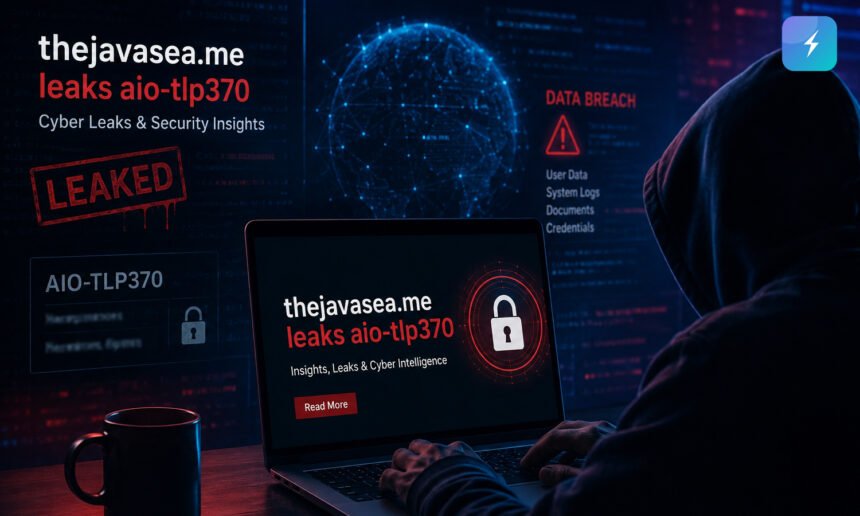
The keyword “thejavasea.me leaks aio-tlp370” has started appearing across search results and online discussions, leading people to ask what AIO-TLP370 actually is, whether it represents a genuine data breach, and whether their personal information could be involved. The technical-looking name can make the subject seem more established than the available evidence supports.
The most important point is that specific claims surrounding AIO-TLP370 remain difficult to verify independently. Several websites describe it as a leak-related archive or package, but reliable public evidence establishing its exact contents, origin, size, affected organizations, or number of impacted users is limited.
For that reason, this guide does not provide links to leaked files or instructions for finding them. Instead, it explains what is known about the term, separates reasonable conclusions from speculation, and covers practical steps readers can take to protect their accounts and devices.
What Is TheJavaSea.me Leaks AIO-TLP370?
The phrase “thejavasea.me leaks aio-tlp370” appears to combine a website name with a leak-related package or reference identifier. Online articles have associated TheJavaSea.me with file-sharing and leak-oriented discussions, while AIO-TLP370 is generally presented as the name or label of a particular archive, bundle, thread, or collection.
That description needs an important qualification: a filename or forum label does not prove that a new cybersecurity breach actually happened.
Some online reports describe AIO-TLP370 as an “all-in-one” collection, while others treat the entire label simply as an informal identifier. There is not enough authoritative public documentation to establish a definitive expansion of every part of the name.
This is why readers should be cautious when encountering articles that provide precise record counts, file sizes, victims, dates, or lists of supposedly exposed information without linking those claims to reliable evidence.
Quick Facts About AIO-TLP370
| Topic | Current understanding |
|---|---|
| Keyword | thejavasea.me leaks aio-tlp370 |
| General topic | Online leaks, digital privacy and cybersecurity |
| AIO-TLP370 | Appears to be an informal archive/package/reference label |
| Confirmed corporate breach | Not publicly confirmed |
| Confirmed number of victims | Not publicly confirmed |
| Exact archive contents | Not independently confirmed |
| Official TLP classification | No |
| Main user concern | Privacy, account security and malware exposure |
| Should unknown leak files be downloaded? | No |
| Safest approach | Use trusted breach-checking and account-security services |
The table highlights the distinction between what is being discussed online and what has actually been established. Treating those categories separately is essential when researching leak-related topics.
Is AIO-TLP370 a Confirmed Data Breach?
Based on currently available public information, AIO-TLP370 should not automatically be described as a confirmed, standalone data breach affecting a known organization.
A confirmed security incident normally has stronger supporting evidence. Depending on the incident, that might include a statement from the affected organization, regulatory notification, security-research findings, technical analysis, or reporting that identifies where the compromised information originated.
Those details are not clearly established for AIO-TLP370.
Some websites make much stronger claims about the package, including descriptions of credentials, source code, API keys, configuration files, logs, or other sensitive information. However, other reports explicitly acknowledge that these claims have not been independently verified.
That difference matters for both accuracy and SEO quality. Repeating an unsupported claim across dozens of websites does not turn it into a verified fact.
What Does AIO-TLP370 Actually Mean?
“AIO” is commonly used online as shorthand for “all-in-one,” especially when multiple tools, resources, files, or datasets have been combined into one collection. It is therefore understandable why many articles interpret the AIO portion of AIO-TLP370 this way.
The rest of the identifier is less certain.
“TLP370” should not be confused with an official cybersecurity Traffic Light Protocol designation. The authoritative Traffic Light Protocol maintained by FIRST uses four labels: TLP, TLP, TLP, and TLP. FIRST states that only labels included in its standard are considered valid TLP labels.
There is no official “TLP370” category in that standard.
Therefore, the safest interpretation is that TLP370 functions as an informal identifier, filename, release code, thread reference, or similar label unless reliable evidence establishes a more specific meaning.
AIO-TLP370 and the Real Traffic Light Protocol
Because “TLP” appears inside AIO-TLP370, some articles have connected the term directly to the Traffic Light Protocol used by cybersecurity professionals. That can create unnecessary confusion.
The real Traffic Light Protocol is an information-sharing standard designed to tell recipients how widely particular information may be shared. FIRST’s current TLP 2.0 specification has been authoritative since August 2022.
Its four labels have different sharing boundaries:
| Official label | General sharing principle |
|---|---|
| TLP | Information should remain with the specified recipients |
| TLP | Sharing is restricted and based on need to know |
| TLP | Information may circulate within an appropriate community |
| TLP | Information may be distributed without TLP-based restrictions |
FIRST also makes clear that TLP is not itself a formal government classification system. Its purpose is to provide understandable boundaries for sharing potentially sensitive information.
Nothing in the official standard establishes “TLP370” as one of these classifications.
Why Unverified Leak Packages Can Be Dangerous
Even when the authenticity of a particular leak is uncertain, files advertised as leaked archives can still create genuine security risks.
Curiosity is one of the easiest ways for malicious actors to persuade people to open unsafe downloads. A file advertised as a database, premium collection, private archive, cracked program, or leaked tool can contain something completely different.
Potential risks include:
- Malware hidden inside executable files or installers
- Credential-stealing software
- Fake login pages designed for phishing
- Malicious scripts inside compressed archives
- Password-protected files that hide suspicious content from basic scanning
- Reused or outdated information presented as a “new” leak
- Copyright, privacy, or legal issues involving unauthorized material
Users therefore do not need to determine whether every AIO-TLP370 claim is genuine before taking sensible precautions. An unknown download is still an unknown download.
The safer approach is to investigate a possible account compromise through legitimate services rather than downloading the material supposedly responsible for it.
How to Check Whether Your Information Has Been Exposed
If you discovered thejavasea.me leaks aio-tlp370 because you are concerned about your email address or account credentials, you do not need to search through leaked archives.
A safer option is Have I Been Pwned, which allows users to check whether an email address appears in known breaches loaded into its database. The service also provides information about documented breaches and offers breach notifications.
If you believe an important account may have been compromised, focus on securing the account itself.
Change the affected password from a trusted device and make the replacement unique. If the same password was used elsewhere, replace it on those accounts as well.
Enable multi-factor authentication wherever available. Also review recent login activity, active sessions, recovery addresses, connected applications, and security notifications.
Be particularly suspicious of emails arriving after a reported breach. Criminals can use breach-related anxiety itself as a phishing technique, sending fake “security alerts” that encourage recipients to click malicious links.
What to Do If You Already Downloaded a Suspicious File
Someone who has already downloaded a file associated with an unknown leak should avoid opening it simply to discover what it contains.
If the file has not been executed or opened, delete it and perform an appropriate security scan using reputable security software. Avoid uploading potentially sensitive stolen material to random online analysis websites because doing so may create additional privacy or legal concerns.
If you opened or executed something suspicious, additional precautions may be appropriate.
Change important passwords using a different, trusted device, particularly if you suspect credential-stealing malware. Review account sessions and sign out devices you do not recognize. Pay special attention to your primary email account because password-reset messages for many other services often go there.
Unexpected authentication prompts, unfamiliar account logins, changed recovery details, new browser extensions, or unexplained security warnings deserve immediate investigation.
How Businesses Should Respond to Leak Claims
Organizations face a different challenge. A leak claim mentioning their company can spread online long before anyone establishes whether the underlying information is genuine.
The first response should be verification rather than public speculation.
Security teams can investigate internal logs, authentication events, endpoint alerts, exposed credentials, unusual API activity, and other indicators relevant to the alleged incident. If credible evidence of compromise exists, the organization can then follow its established incident-response process and applicable notification requirements.
Businesses should also consider whether exposed credentials have been reused across systems. Password reuse can transform an old third-party breach into a current security problem.
Most importantly, organizations should not download questionable archives onto normal corporate devices simply because someone online claims those archives contain company data. Investigation should follow appropriate security and legal procedures.
How to Judge Claims About TheJavaSea.me Leaks AIO-TLP370
Search results can make an unverified story look authoritative because numerous websites may repeat essentially the same information.
A better approach is to examine the quality of the evidence.
Ask whether the article identifies an affected organization. Look for an original disclosure, credible security analysis, regulator notice, or statement from the organization concerned. Check whether supposedly precise numbers have an identifiable source.
Be cautious when an article claims that millions of accounts were compromised but provides no evidence showing where that figure came from.
Likewise, a screenshot of a folder or archive is not sufficient proof. Filenames can be created by anyone, and collections can contain duplicated, fabricated, outdated, or publicly available information.
For AIO-TLP370 specifically, important details such as the exact contents, origin, victim count, and status as a distinct breach remain insufficiently verified in reliable public sources.
Privacy and Ethical Issues Around Leaked Content
Data leaks are not merely technical events. They can affect real people whose personal information, photographs, conversations, account credentials, financial details, or work documents were never intended for public distribution.
Searching for information about an alleged incident for security awareness is very different from downloading or redistributing private material.
Readers should avoid reposting personal information obtained from questionable sources. Sharing leaked material can amplify the original privacy violation and potentially expose additional people to scams, harassment, identity theft, or other harm.
Website publishers covering leak-related keywords should follow the same principle. An informative article can explain the event, uncertainty, security implications, and protective measures without linking directly to unauthorized material.
That approach produces more useful content while respecting the people potentially affected.
Final Thoughts
Thejavasea.me leaks aio-tlp370 is a good example of why leak-related search terms require careful research. The phrase is widely discussed online, but repetition should not be mistaken for verification. Available information supports treating AIO-TLP370 as a leak-related identifier or alleged archive label rather than confidently presenting it as a fully documented cybersecurity incident.
One point can be established clearly: “TLP370” is not an official Traffic Light Protocol classification. FIRST’s recognized TLP 2.0 system consists of TLP, TLP, TLP, and TLP.
For ordinary users, the practical response is simple. Avoid questionable downloads, use unique passwords, enable multi-factor authentication, check accounts through reputable breach-notification services, and treat dramatic claims cautiously until reliable evidence appears. You can understand the risks surrounding thejavasea.me leaks aio-tlp370 without accessing or redistributing potentially unauthorized material.
Frequently Asked Questions
What is thejavasea.me leaks aio-tlp370?
It is a search phrase associated with online discussions of an alleged leak-related archive, package, or collection identified as AIO-TLP370. Its exact contents, source, and scope have not been reliably established through authoritative public evidence.
Is AIO-TLP370 a confirmed data breach?
There is not enough reliable public evidence to describe AIO-TLP370 confidently as a single, independently verified breach of a particular organization. Several websites discuss the label, but important details remain unconfirmed.
Does TLP370 mean Traffic Light Protocol?
There is no official TLP370 designation in FIRST’s Traffic Light Protocol. TLP 2.0 recognizes only TLP, TLP, TLP, and TLP.
Is it safe to download AIO-TLP370 files?
Downloading unknown leak-related files is not recommended. Their authenticity and contents may be uncertain, and unknown archives can introduce malware, credential theft, privacy problems, or legal risks.
How can I find out whether my email was exposed?
Instead of searching through leaked databases, use an established breach-notification service such as Have I Been Pwned. It lets users check email addresses against breaches included in its database.
What should I do if my password appears in a breach?
Change the affected password immediately and avoid reusing it on other accounts. Replace reused versions elsewhere, enable multi-factor authentication where possible, review active sessions, and watch for suspicious emails or unexpected login attempts.